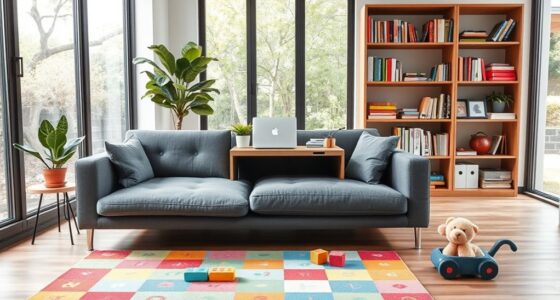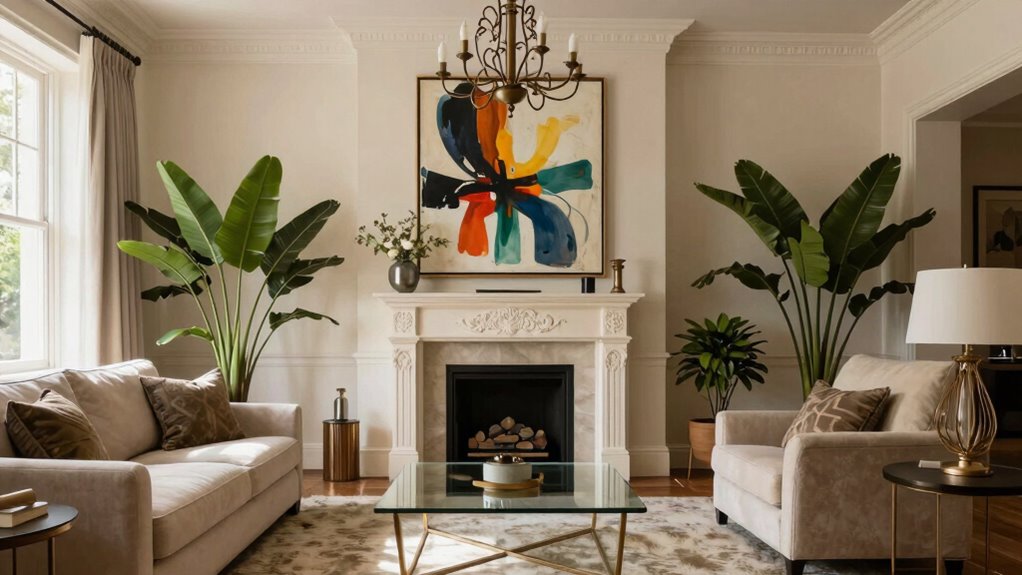

To design a room with multiple focal points, use bold colors and contrasting tones to highlight different features, and arrange furniture to naturally guide the eye toward each one. Balance bold elements with softer backgrounds, and position lighting to accentuate key areas. Create a visual hierarchy so no focal point overwhelms the others, and plan sightlines to keep everything visible from multiple angles. Keep exploring these strategies to master an engaging, harmonious space.

Get furniture and decor delivered free with Prime
- Fast, free delivery on millions of items
- Prime Video, Amazon Music and more included
- Member-only deals all year
Key Takeaways
- Use contrasting colors and tones to distinguish each focal point and prevent visual clutter.
- Arrange furniture to frame and direct attention to multiple features simultaneously.
- Establish visual hierarchy by prioritizing focal points based on importance and size.
- Incorporate strategic lighting to highlight each focal point without overshadowing others.
- Balance the room with harmonious color schemes and thoughtful layout for a cohesive, lively space.
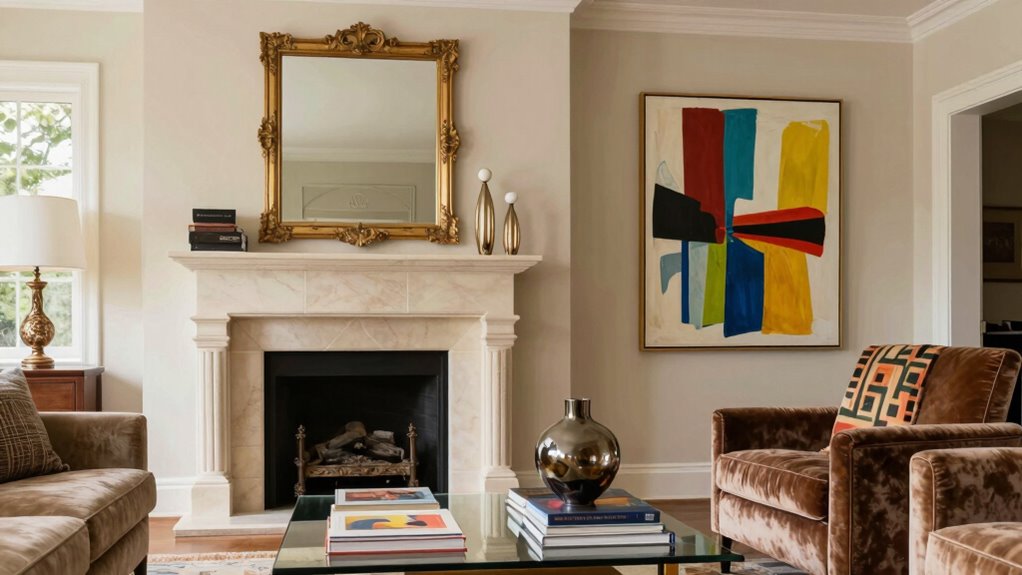
Designing a room with multiple focal points can create a dynamic and visually interesting space, but it requires careful planning to avoid chaos. When you introduce more than one area of emphasis, you need to think about how these points interact and guide the eye without overwhelming the room. One effective way to do this is through thoughtful use of color contrast. Bright, bold hues can draw attention to specific features, like a piece of artwork or a statement piece of furniture, while softer, muted tones can serve as a backdrop that allows other focal points to stand out. For example, if you have a vibrant sofa, consider painting the wall behind it in a contrasting color, such as deep navy or emerald green, to make both elements pop without competing for attention. You want each focal point to have its own visual weight, so balancing these contrasts is key.
Balance bold and muted tones to highlight multiple focal points without overwhelming the space.
Next, your furniture arrangement plays a crucial role in how well you can manage multiple focal points. You don’t want furniture to block important features or create confusion. Instead, position seating to frame each focal point clearly, guiding the eye naturally from one feature to the next. For instance, if you’ve got a fireplace and a large window, arrange your sofa and chairs so they face both, perhaps creating a semi-circular seating area. This not only highlights both focal points but also encourages conversation and movement within the space. Keep in mind that clear sightlines matter: you want each focal point to be easily visible from different angles, which means avoiding cluttered or overly dense furniture arrangements. Incorporating contrast ratios can further enhance the visual separation between different features, making each stand out more distinctly. Additionally, understanding visual hierarchy can help you determine which focal points should command more attention and how to balance them effectively.
Lighting is another tool that helps highlight multiple focal points effectively. Use adjustable lighting—like spotlights or table lamps—to accentuate key features without overwhelming the room. For example, a picture light above artwork and a floor lamp near a reading nook can draw attention simultaneously to different parts of the room, reinforcing the multiple focal points. Proper lighting placement can also add depth and dimension, making each feature more prominent and visually appealing.
Ultimately, the key to successfully designing a room with more than one focal point is to strike a balance. Use color contrast strategically to make each feature stand out, and arrange your furniture thoughtfully to create flow and emphasis. When you craft a space with these elements in mind, you guide your eye naturally through the room, making it feel lively and intentional rather than chaotic. With careful planning, your room will become a vibrant, inviting space that showcases multiple points of interest without sacrificing harmony.
adjustable spotlight for artwork
As an affiliate, we earn on qualifying purchases.
As an affiliate, we earn on qualifying purchases.
Frequently Asked Questions
How Do I Ensure Focal Points Don’T Compete Visually?
To guarantee focal points don’t compete visually, you should balance lighting and create texture contrast. Use different lighting levels to highlight each focal point without overpowering others, guiding your eye smoothly around the room. Incorporate contrasting textures—like smooth versus rough surfaces—to distinguish each feature clearly. This approach helps each focal point stand out uniquely, maintaining visual harmony and preventing clutter or confusion in your space.
Can Multiple Focal Points Work in Small Rooms?
Yes, multiple focal points can work in small rooms. You can use decorative accessories like colorful vases or artwork to create visual interest, but avoid clutter. Implement lighting techniques such as spotlights or layered lighting to highlight each focal point without overwhelming the space. Keep the room balanced by spacing out these elements, ensuring each focal point stands out without competing for attention, making your small room feel dynamic yet cohesive.
What Colors Best Highlight Multiple Focal Points?
You should choose colors that create strong contrast to highlight multiple focal points effectively. Use bold or complementary hues to make each feature stand out. Incorporate accent lighting to draw attention without overwhelming the space, guiding the eye naturally across the room. This combination of contrasting colors and strategic lighting helps each focal point shine while maintaining a cohesive, inviting atmosphere.
How Many Focal Points Should a Room Have?
You should aim for two to three focal points to create visual interest without overwhelming the space. Remarkably, rooms with multiple focal points can increase perceived room size by up to 20%. Use decorative accessories strategically and lighting strategies to emphasize each feature. Balance is key—ensure each focal point has its own space, so you maintain harmony and draw attention naturally across the room.
Should Focal Points Be Symmetrical or Asymmetrical?
Focal points should be asymmetrical to create visual interest and dynamic balance. Use decorative accents like varying artwork or statement furniture to emphasize each focal, while lighting techniques such as layered lighting or spotlights highlight different areas. This approach keeps the room lively and engaging, encouraging the eye to move naturally around the space. Avoid symmetry, which can make the room feel static and less inviting.
As an affiliate, we earn on qualifying purchases.
Conclusion
Now that you know how to create multiple focal points, your room will become an unstoppable magnet for attention—so enchanting that even a goldfish would forget to swim in circles! With carefully chosen art, furniture, and lighting, you’ll turn your space into a visual masterpiece that dazzles everyone who steps inside. Get ready for your room to be the talk of the town, leaving visitors utterly mesmerized and wondering how you pulled off such a stunning design!
contrast color wall paint samples
As an affiliate, we earn on qualifying purchases.
As an affiliate, we earn on qualifying purchases.
furniture arrangement guide for living room
As an affiliate, we earn on qualifying purchases.
As an affiliate, we earn on qualifying purchases.
Halloween Picks
halloween
As an affiliate, we earn on qualifying purchases.