
TL;DR

Get furniture and decor delivered free with Prime
- Fast, free delivery on millions of items
- Prime Video, Amazon Music and more included
- Member-only deals all year
Recent research highlights how Antoni Gaudí’s crypt at Colònia Güell pioneered design principles that later shaped parametricism. This connection offers new insights into architectural evolution and innovation.
Recent scholarly analysis confirms that Antoni Gaudí’s crypt at Colònia Güell played a significant role in shaping the principles of parametricism, a contemporary architectural style. This revelation links historic organic architecture with modern computational design, offering new insights into the evolution of architectural innovation and influencing current design practices.
Researchers have identified key structural and formal elements of Gaudí’s crypt that prefigure the core concepts of parametricism, such as complex geometries, organic forms, and innovative structural systems. These features, originally conceived through manual modeling and natural inspiration, demonstrate an early form of parametric thinking, which has now become central to digital architecture.
Architectural historians and computational designers note that Gaudí’s approach to form, which integrated natural shapes with structural ingenuity, aligns with the principles of parametricism, emphasizing fluidity, adaptability, and complex surface manipulation. This connection is supported by recent publications and digital reconstructions analyzing Gaudí’s methods.
While it is widely acknowledged that Gaudí’s work was groundbreaking in its organic forms, the specific influence on the development of parametric design is a recent focus of scholarly debate, with some experts emphasizing a conceptual lineage rather than direct technical influence.
Impact of Gaudí’s Organic Forms on Modern Design
This discovery underscores the deep historical roots of parametricism, challenging the notion that it is solely a product of digital technology. Recognizing Gaudí’s crypt as a precursor highlights how manual and naturalistic design approaches can anticipate computational methods, influencing contemporary architecture’s shift toward complex, adaptable forms.
For architects and designers, this connection offers a broader perspective on innovation, blending historic craftsmanship with cutting-edge digital tools. It also elevates Gaudí’s work as a foundational influence on a style that dominates current architectural experimentation.
parametric design software for architects
As an affiliate, we earn on qualifying purchases.
As an affiliate, we earn on qualifying purchases.
Gaudí’s Organic Architecture and Its Evolution
Antoni Gaudí, active in the late 19th and early 20th centuries, is renowned for his organic, highly expressive architectural style, exemplified by structures like the Sagrada Família and the crypt at Colònia Güell. His innovative structural techniques and naturalistic forms broke away from traditional architectural conventions, emphasizing fluidity and complexity.
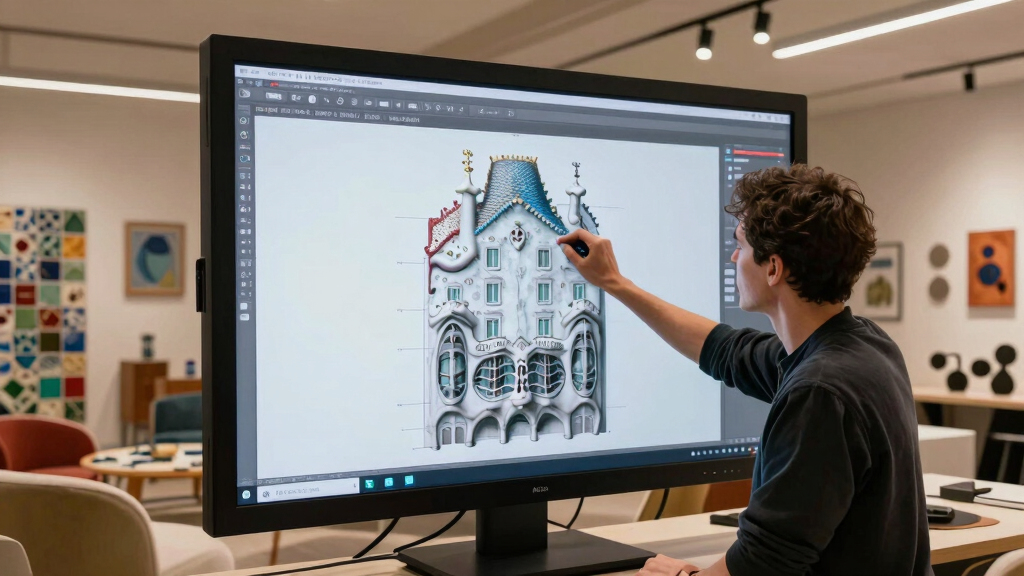
The crypt, built as part of the Güell colony project, features hyperbolic paraboloids, catenary arches, and intricate surface geometries—all manually modeled but resembling the complex, adaptable forms associated with modern parametric design. Recent digital reconstructions have begun to analyze these forms through computational modeling, revealing their alignment with parametric principles.
Historically, Gaudí’s work has been viewed as a precursor to modern organic architecture, but its direct influence on digital design paradigms has only recently been explored, bridging the gap between manual craftsmanship and computational innovation.
“Gaudí’s crypt embodies early principles of parametric thinking, especially in its complex geometries and organic forms, which prefigure modern computational design.”
— an anonymous researcher
organic architecture modeling tools
As an affiliate, we earn on qualifying purchases.
As an affiliate, we earn on qualifying purchases.
Extent of Gaudí’s Influence on Digital Parametricism
While research shows structural and conceptual similarities, it remains unclear how directly Gaudí’s methods influenced specific parametric tools and processes used today. The degree of intentional influence versus coincidental similarity is still under scholarly debate, and further digital analysis is needed to establish definitive links.
computational design tools for architecture
As an affiliate, we earn on qualifying purchases.
As an affiliate, we earn on qualifying purchases.
Further Research and Digital Reconstruction of Gaudí’s Work
Ongoing projects aim to create detailed digital models of Gaudí’s structures, including the crypt, to better understand their geometric logic. Future studies will explore how these historic forms can inform contemporary parametric workflows and architectural education. Additionally, scholars plan to investigate other early organic structures for similar influences.
Gaudí inspired architectural models
As an affiliate, we earn on qualifying purchases.
As an affiliate, we earn on qualifying purchases.
Key Questions
How does Gaudí’s crypt relate to modern parametric design?
Recent analysis shows that the complex geometries and organic forms of Gaudí’s crypt prefigure core principles of parametricism, suggesting a conceptual link between manual craftsmanship and digital design methods.
Was Gaudí aware of parametric principles when designing the crypt?
No, Gaudí was not aware of digital parametric tools; however, his intuitive approach to form and structural innovation aligns with the underlying concepts of parametric design.
Why is this connection important for contemporary architecture?
Understanding Gaudí’s work as a precursor to parametricism broadens the historical context of digital design, showing how organic, complex forms have long been part of architectural innovation.
Are there other examples of historic architecture influencing parametric design?
Yes, several organic and structural innovations from historic architecture are being reinterpreted through digital modeling, but Gaudí’s crypt is now recognized as a key early example.
What are the implications for architectural education?
This connection encourages integrating historic organic architecture with digital design techniques, fostering a more holistic understanding of form and structure among students.
Source: Dezeen
Halloween Picks
halloween
As an affiliate, we earn on qualifying purchases.