
TL;DR

Get furniture and decor delivered free with Prime
- Fast, free delivery on millions of items
- Prime Video, Amazon Music and more included
- Member-only deals all year
Livingetc’s bathroom design report presents wallpaper as a way to make powder rooms and bathrooms more expressive, with examples ranging from leafy prints to stripes and textured finishes. The article offers design inspiration, not performance testing; it does not establish which papers are suitable for wet areas or provide installation guidance.
Livingetc’s bathroom design report argues that wallpaper can turn a bathroom or powder room into a more expressive part of the home, illustrating the idea with projects that use foliage, fine-line drawings, stripes and textured patterns. The examples show how designers have used wallcoverings to add character to compact rooms, but the article is design inspiration rather than technical guidance and does not establish which products can withstand moisture or direct water exposure.
The report’s central point is that bathrooms can offer a contained place to use a bolder pattern than homeowners might choose for a larger, more frequently seen space. It describes a shift away from treating bathrooms as purely functional rooms and presents wallpaper as one way to give them a distinct visual identity. That is the article’s design perspective, not a measured finding about how people use or value bathrooms.
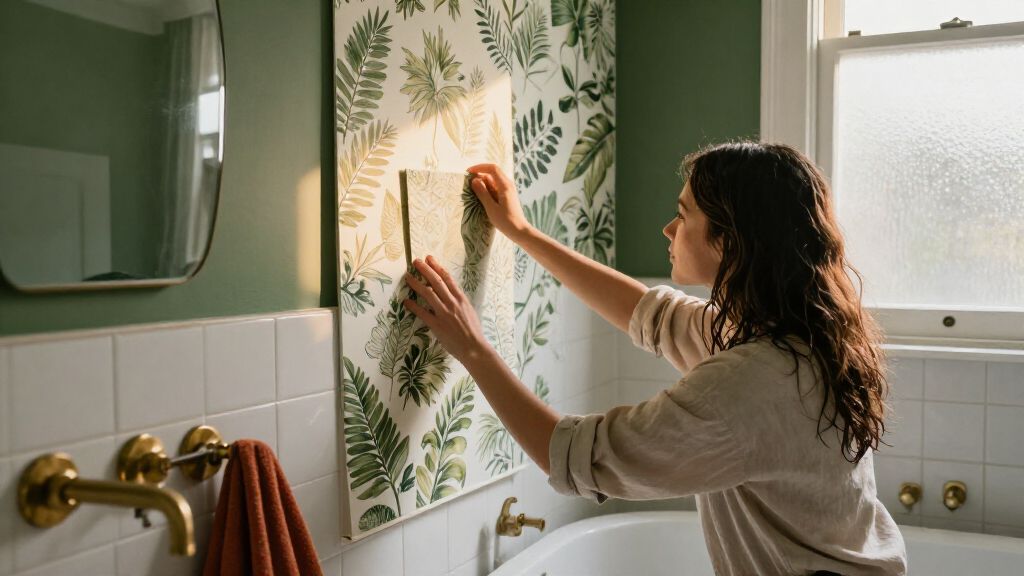
Its examples cover several approaches. In a Philadelphia powder room, designer Brittany Hakimfar used leafy foliage and exotic-tree imagery to bring warmth and visual drama to a small space. In an Art Deco apartment renovation, designer Sheena Holton used fine-line illustrations to make a bathroom feel more playful despite limited natural light. Holton said the existing developer-designed bathroom could not be changed, so she focused on making it “a fun space.”
Other projects show wallpaper used selectively or in combination with other finishes. C&M Interiors’ Maria Hogrefe said a client’s wallpaper, depicting historic-style figures, was used sparingly but helped tie the room together. Kristin Fine and Analisse Taft-Gerste of The 1818 Collective described stripes as a way to create rhythm, including in loft bathrooms with sloping ceilings. The report also features a wallpapered wardrobe door concealing an ensuite, a floral paper paired with patterned tile and shower finishes, and a crocodile-effect green wallcovering with brass hardware.
How Wallpaper Changes Bathroom Design
The examples point to wallpaper’s role as a visual organizing choice, not simply a decorative layer. A print can set a room’s mood, connect colors in tile and fixtures, or provide a focal point where space is limited. The report shows designers using both restrained applications, such as a single wall, and more layered schemes that combine wallpaper with patterned tile or other finishes.
For readers planning a renovation, the distinction between a powder room and a shower area matters. The source includes many small bathrooms and powder rooms, where wallcovering can be away from direct water. It does not supply product specifications or confirm suitability for wet zones. Homeowners should check the manufacturer’s instructions and get qualified advice on surface preparation, ventilation and placement before choosing wallpaper for a bathroom.
Products Worth Considering

Blueair Blue Pure 511i Max Smart Air Purifier

Levoit Core 300S-P Smart Wi-Fi Air Purifier

Sonos Era 100 SL Compact, Microphone-Free Speaker – Black
As an affiliate, we earn on qualifying purchases.
The Projects Behind the Trend
Livingetc frames its examples around the idea that intimate rooms can accommodate design choices that might feel too bold elsewhere in a home. The projects span different styles rather than describing a single coordinated trend: botanical imagery, delicate line work, pale stripes, moiré-like texture and crocodile-effect finishes all appear. Several examples rely on coordination with existing materials, including marble, brass, tile and painted trim.
The report also emphasizes practical design responses to room conditions. Holton’s bathroom had little natural light, while a featured loft bathroom had a slanted ceiling. Other projects used mirrors or pale backgrounds alongside dense patterns. These are the designers’ approaches as described by Livingetc; the article does not provide comparative measurements or establish that any one treatment will make a bathroom look larger or brighter in every home.
““The wallpaper was used sparingly, but it truly ties everything together with historic-style nude muses with an antiqued backdrop.””
— Maria Hogrefe of C&M Interiors, as quoted by Livingetc
Moisture Suitability Is Not Addressed
The source does not identify wallpaper brands or materials, report how the coverings have performed over time, or specify whether the featured bathrooms include showers with direct spray. It also gives no installation or maintenance instructions and does not compare wallpaper with paint or tile for durability. Those details are necessary before treating the projects as guidance for a particular bathroom. Product suitability, ventilation needs and installation requirements remain unconfirmed in the report.
Check Products Before Installation
Livingetc’s article supplies visual examples, but it does not announce a product launch, renovation program or follow-up report. Anyone considering the look will need to check the wallcovering manufacturer’s stated use and care requirements, especially where humidity or water exposure is likely. The next decision is practical as well as aesthetic: determine where the paper will go, what the room’s conditions are, and whether the chosen product and installation method are appropriate.
Key Questions
What is the main point of Livingetc’s bathroom wallpaper report?
It presents wallpaper as a way to add pattern, texture and personality to bathrooms and powder rooms, using examples from interior design projects.
Does the report say wallpaper is suitable inside a shower?
No. The source does not assess products for direct water exposure or provide installation specifications. Check a product’s manufacturer guidance before using it in a wet area.
Can wallpaper be used on just one bathroom wall?
Yes, one featured project used wallpaper sparingly. The report presents limited application as one design approach, but the right placement depends on the room and the product’s stated use.
What kinds of wallpaper appear in the examples?
The projects include leafy and palm patterns, fine-line illustrations, stripes, floral prints and textured or crocodile-effect finishes.
Does the article establish that wallpaper makes a bathroom look bigger?
No. It describes design choices in particular rooms but does not provide measurements or evidence that wallpaper reliably changes the perceived size of a bathroom.
Source: livingetc.com