If you’re looking for the best 130mm triplet APO refractors for astrophotography, I recommend models with high-quality ED glass, precise optics, and flat-field correction for stunning celestial images. These scopes offer excellent color correction, portability, and sharpness, making them ideal for detailed planetary and deep-sky shots. From Explore Scientific to SVBONY options, I’ll share top picks that balance performance and value. Keep exploring to discover the perfect telescope to elevate your astrophotography game.
Key Takeaways
- High-quality 130mm triplet APOs with ED glass and multi-coated optics ensure sharp, color-accurate images for stunning astrophotography.
- Focal ratios around f/6 to f/7.5 provide versatile wide-field and high-magnification imaging capabilities.
- Durable, lightweight build with precise focusers like dual-speed HEX models guarantees reliable, detailed celestial shots.
- Flat-field correctors and internal light barriers deliver edge-to-edge sharpness essential for astrophotography.
- Reputable brands offer comprehensive warranties and support, ensuring long-term investment in top-performing refractors.
SVBONY SV550 Triplet APO Telescope (122mm F7 ED Refractor)
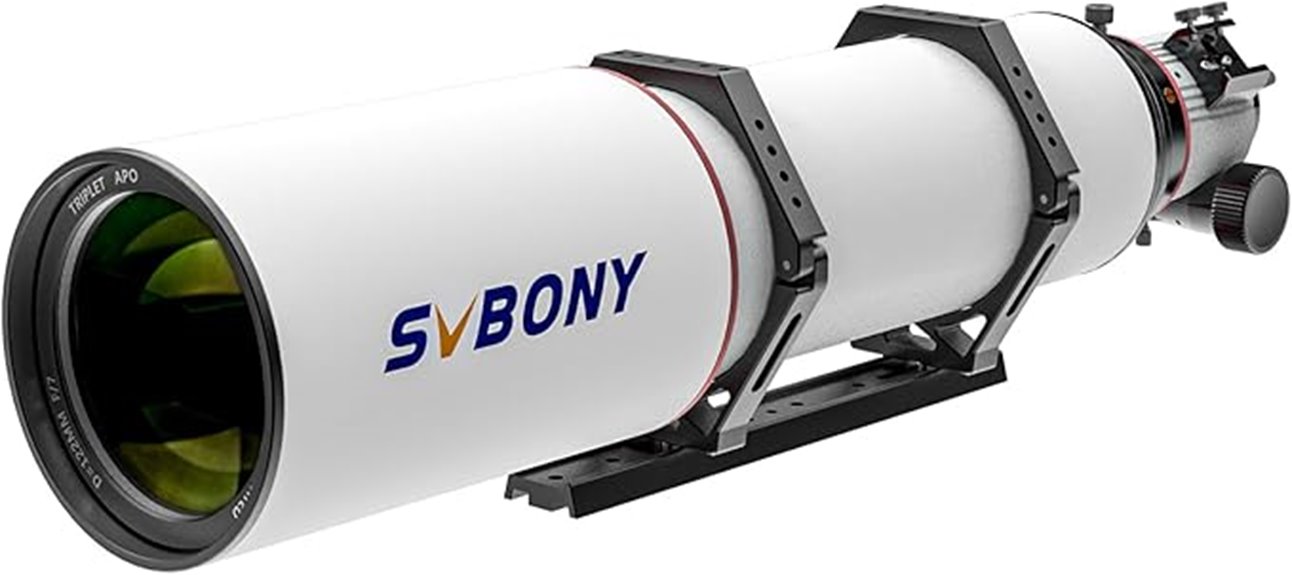
If you’re looking for a portable yet powerful telescope for astrophotography, the SVBONY SV550 Triplet APO Refractor stands out as an excellent choice. Its 122mm aperture and F7 focal ratio provide bright, sharp images of deep sky objects. The high-quality FPL-51 triplet lens with ED glass corrects aberrations for clearer results. Weighing just over 6.4kg, it’s easy to carry and setup, thanks to its compact design. The 2.5-inch dual-speed focuser offers precise focusing, essential for detailed astrophotography. Overall, this telescope combines portability, excellent optics, and versatility, making it an ideal tool for capturing stunning celestial images.
Best For: amateur astronomers and astrophotographers seeking a portable, high-quality telescope for deep sky observation and imaging.
Pros:
- High-quality FPL-51 triplet ED lens reduces chromatic aberration for sharper images
- Compact and lightweight design (just over 6.4kg), easy to transport and set up
- Precise 2.5-inch dual-speed focuser allows for accurate focusing essential for astrophotography
Cons:
- Focal length of 854mm may be limiting for very detailed planetary imaging compared to longer focal length scopes
- Price may be higher relative to entry-level refractors with simpler optics
- Requires additional accessories (like mounts and cameras) for full astrophotography setup
Explore Scientific ED102 Telescope for Astrophotography
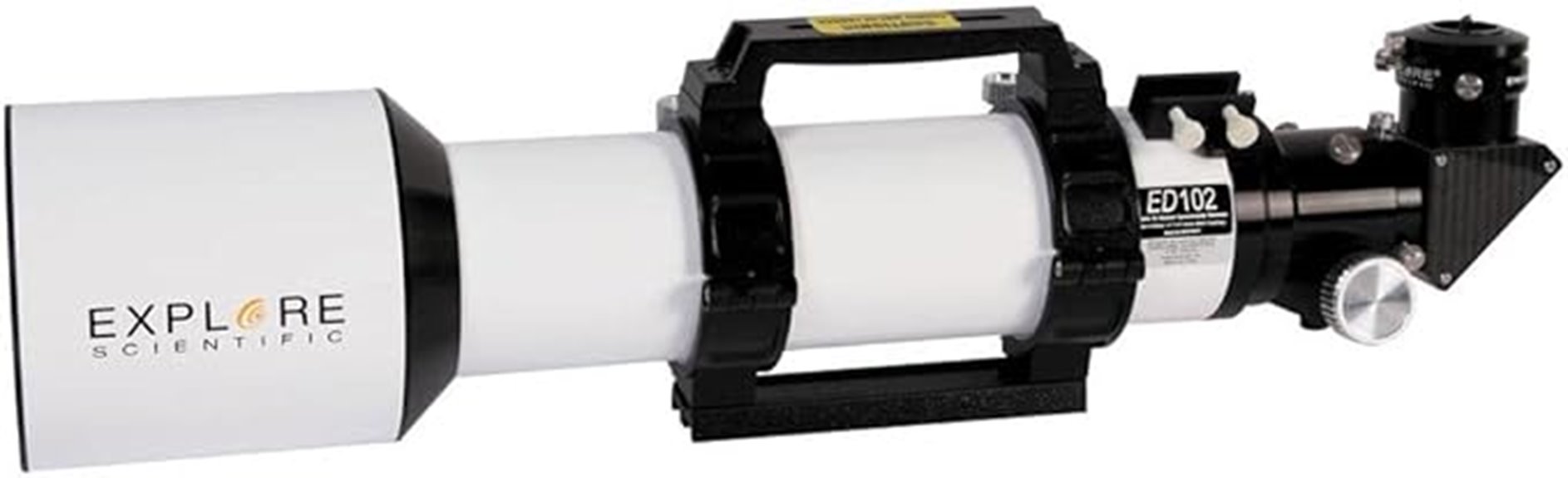
The Explore Scientific ED102 Telescope stands out as an excellent choice for astrophotographers who demand high optical quality in a portable package. Its 102mm aperture and f/7 focal ratio, combined with an air-spaced triplet design, deliver stunning, high-contrast images with minimal chromatic aberration. The use of genuine FCD1 HOYA ED glass and multi-layer coatings ensures sharp, detailed views of the Moon, planets, nebulae, and star clusters. Designed for astrophotography, its 714mm focal length enables capturing bright deep-sky objects with precision. Plus, its portable build, retractable dew shield, and easy collimation system make setup simple, making it a versatile and reliable tool for celestial imaging.
Best For: astrophotographers seeking a portable, high-quality apochromatic refractor capable of capturing detailed images of the Moon, planets, nebulae, and star clusters.
Pros:
- High optical quality with genuine FCD1 HOYA ED glass and multi-layer coatings for sharp, high-contrast images
- Effective chromatic aberration correction thanks to air-spaced triplet design and f/7 focal ratio
- Portable design with retractable dew shield and user-friendly collimation system for easy setup and maintenance
Cons:
- May be more expensive compared to entry-level telescopes with similar apertures
- Limited aperture size might restrict extremely deep-sky imaging compared to larger scopes
- Requires additional accessories like mounts and cameras for full astrophotography setup
Explore Scientific ED80 Triplet Refractor Telescope for Astrophotography

For astrophographers seeking a portable yet high-performance telescope, the Explore Scientific ED80 Triplet Refractor stands out as an excellent choice. Its compact 80mm aperture and 480mm focal length, combined with genuine FCD1 HOYA ED glass and multi-layer coatings, deliver sharp, high-contrast images free of chromatic aberration. Designed for astrophotography, it supports capturing the Moon, planets, nebulae, and star clusters with ease. The air-spaced triplet system ensures excellent image clarity, while the retractable dew shield and precision collimation make setup quick and straightforward. Overall, the ED80 offers a versatile, reliable platform for both visual and deep-sky imaging.
Best For: astrophotographers and amateur astronomers seeking a portable, high-quality telescope capable of capturing detailed images of the Moon, planets, nebulae, and star clusters.
Pros:
- High-contrast, sharp images with minimal chromatic aberration thanks to genuine FCD1 HOYA ED glass and multi-layer coatings.
- Compact and lightweight design with a retractable dew shield, ideal for spontaneous stargazing and travel.
- Precise collimation system ensures tight star images, supporting high-quality astrophotography and deep-sky observation.
Cons:
- Price may be higher compared to beginner-level telescopes, reflecting its advanced optical quality.
- Limited aperture size (80mm), which may restrict deep-sky imaging of very faint objects for advanced astrophotographers.
- Availability and shipping options may vary across stores, potentially affecting immediate purchase options.
Explore Scientific FCD100 Series 80mm Air-Spaced Apochromatic Triplet Refractor Telescope

Designed for astrophotographers who demand exceptional clarity in a portable package, the Explore Scientific FCD100 Series 80mm Air-Spaced Apochromatic Triplet Refractor delivers stunning, high-contrast images. It uses genuine Hoya FCD100 ED glass with multi-layer coatings, ensuring sharp, color-accurate views. The air-spaced triplet design virtually eliminates chromatic aberration, making details crisp. With an 80mm aperture, f/6 focal ratio, and 480mm focal length, it excels in capturing Moon, planets, nebulae, and galaxies. Its lightweight, compact build, combined with features like a dew shield and precise focuser, makes it ideal for spontaneous, high-quality astrophotography sessions.
Best For: amateur astronomers and astrophotographers seeking a portable, high-quality apochromatic refractor for detailed celestial imaging and visual observation.
Pros:
- Utilizes genuine Hoya FCD100 ED glass with multi-layer coatings for exceptional optical clarity and color accuracy.
- Virtually eliminates chromatic aberrations due to its air-spaced triplet design, resulting in sharp, high-contrast images.
- Compact, lightweight build with features like a precise focuser and versatile mounting options, ideal for spontaneous and mobile stargazing.
Cons:
- May require additional accessories such as mounts or adapters for optimal astrophotography setups.
- Slightly higher price point compared to simpler refractors, reflecting its advanced optical design.
- Limited aperture size (80mm), which, while excellent for portability, may restrict deep-sky imaging compared to larger telescopes.
Celestron StarSense Explorer DX 130AZ Telescope with Smartphone Dock
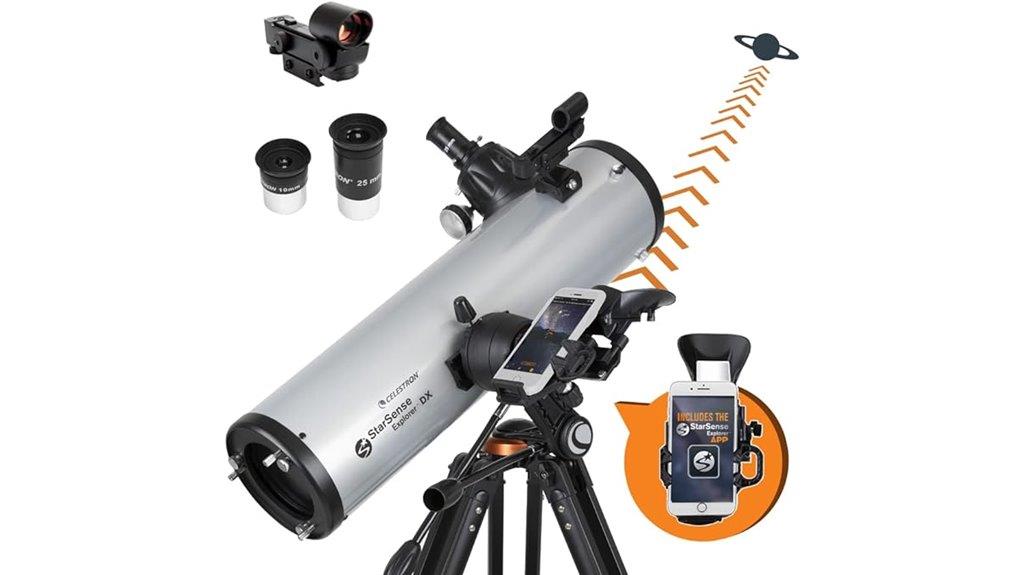
If you’re a beginner enthusiastic to explore the night sky without the hassle of complex setups, the Celestron StarSense Explorer DX 130AZ Telescope with Smartphone Dock is an excellent choice. Its 130mm Newtonian reflector offers sharp views of the Moon, planets, and deep-sky objects like Orion and Andromeda. The manual altazimuth mount with slow-motion controls makes tracking easy. The StarSense app transforms your phone into a navigation tool, guiding you to celestial targets with on-screen arrows and star pattern analysis. Setup is simple, and the intuitive controls make stargazing accessible, backed by Celestron’s trusted brand and a 2-year warranty.
Best For: beginners and amateur astronomers seeking an easy-to-use, smartphone-integrated telescope for exploring the night sky with minimal setup.
Pros:
- User-friendly setup and intuitive controls ideal for beginners
- Smartphone app provides guided navigation and object identification
- Sharp views of the Moon, planets, and deep-sky objects with a 130mm reflector
Cons:
- Manual mount requires some practice for precise tracking
- Limited advanced features for experienced astronomers
- Smartphone docking and app reliance may affect usability in certain conditions
Explore Scientific FCD100 Series ED102 Refractor Telescope (OTA Only)
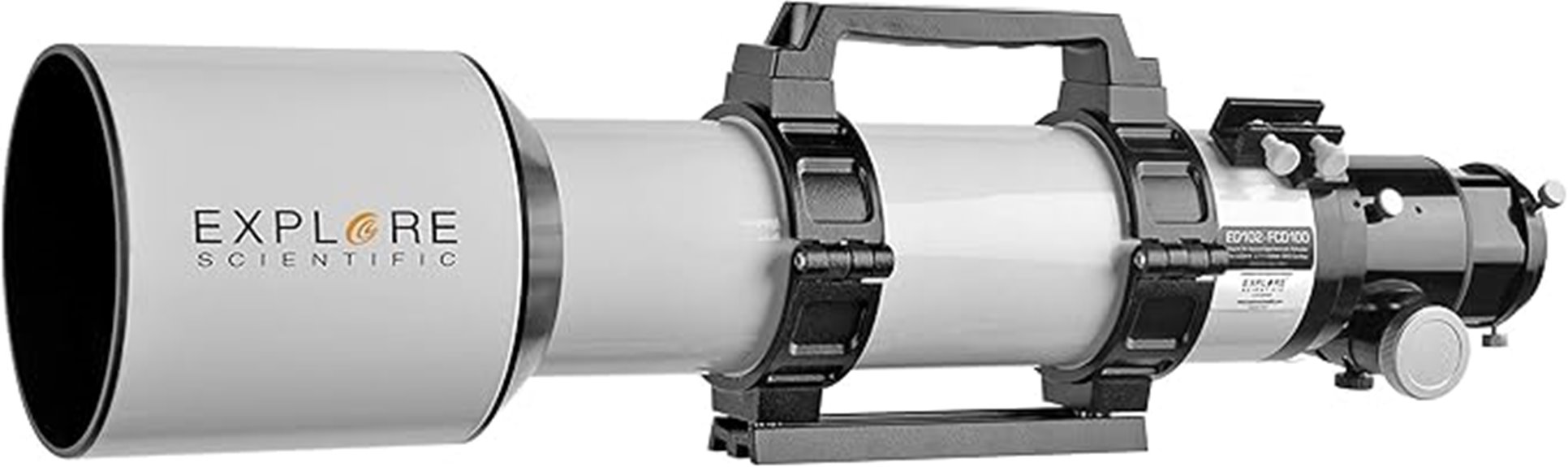
The Explore Scientific FCD100 Series ED102 Refractor Telescope stands out as an excellent choice for astrophotographers seeking high-quality images with minimal chromatic aberration. Its 102mm aperture and f/7 focal ratio deliver sharp, detailed celestial shots. The use of genuine HOYA FCD100 ED glass and proprietary multi-layer coatings guarantees excellent color correction and contrast. Weighing just under 11 pounds, this OTA offers a lightweight yet sturdy build, making it versatile for various setups. With a 714mm focal length and 1.14 arcsecond resolution, it’s perfect for capturing stunning planetary and deep-sky images. This refractor is a reliable tool for serious astrophotographers.
Best For: astrophotographers seeking high-precision, low-chromatic aberration images of celestial objects with a lightweight and durable refractor telescope.
Pros:
- Genuine HOYA FCD100 ED glass provides excellent color correction and sharp images
- Proprietary multi-layer coatings enhance contrast and reduce glare
- Lightweight design (10.9 lbs.) makes it versatile and easy to handle
Cons:
- OTA only, requiring additional accessories for complete setup
- Limited aperture size may restrict some deep-sky imaging compared to larger telescopes
- Fixed focal length of 714mm may limit versatility for wide-field views
SVBONY SV105 Telescope Camera, 1.25″ CMOS Astrophotography Camera
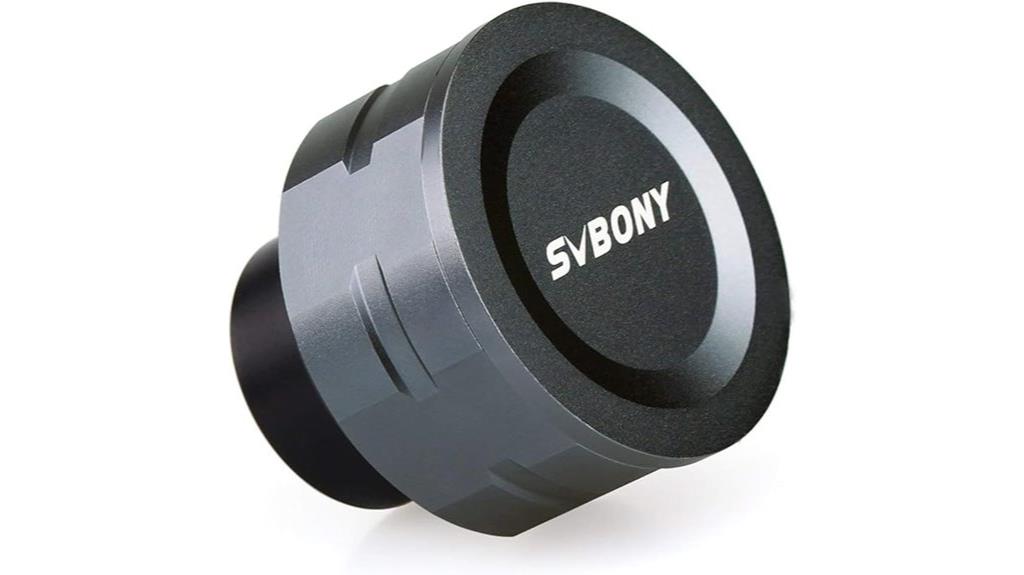
For beginners venturing into astrophotography, the SVBONY SV105 Telescope Camera offers an easy-to-use solution that delivers high-quality images without complex setup. Its 1/2.8-inch CMOS sensor captures sharp, detailed lunar, planetary, and terrestrial shots at 1080p resolution and 30 fps. The camera connects seamlessly via USB to Windows, Linux, or Android devices, supporting real-time viewing and 2K video recording. With plug-and-play simplicity and dark light compensation technology, it’s perfect for those starting out. Its compatibility with standard telescope filters and eyepiece threading makes it versatile for various setups. Overall, the SV105 is an affordable, straightforward choice for capturing stunning celestial details.
Best For: beginners in astrophotography seeking an easy, affordable way to capture lunar, planetary, and terrestrial images with real-time viewing.
Pros:
- User-friendly, plug-and-play setup ideal for newcomers
- High-quality 1080p video recording at 30 fps and 2K support
- Compatible with Windows, Linux, and Android devices for versatile use
Cons:
- Not compatible with iOS devices such as phones and tablets
- Limited to 1.25-inch telescope interfaces, which may restrict some setups
- Entry-level features may lack advanced imaging options for experienced astrophotographers
Celestron Omni XLT 120 Refractor Telescope
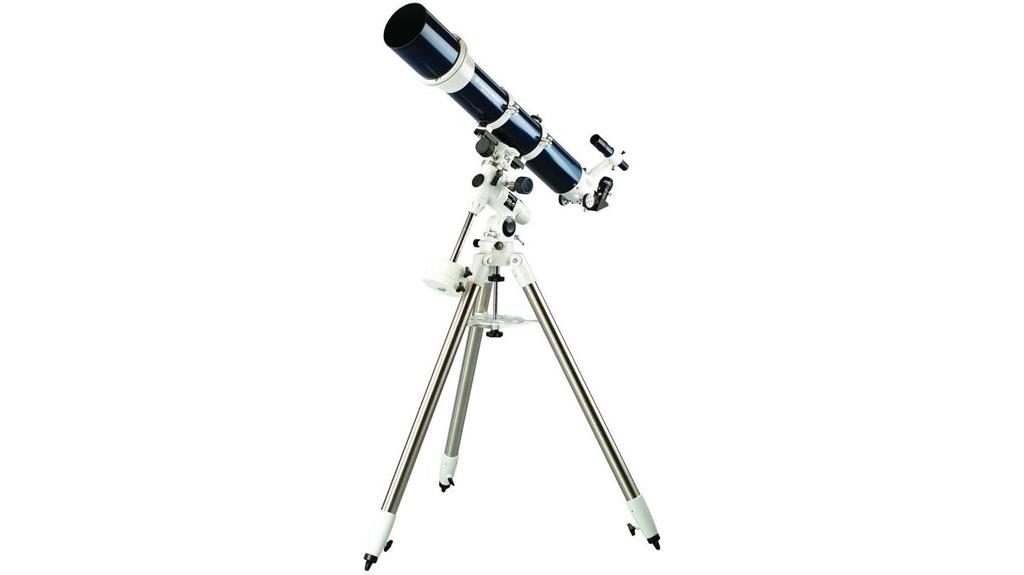
Designed for amateur astronomers who prioritize image clarity and precise tracking, the Celestron Omni XLT 120 Refractor Telescope combines high-quality optics with a reliable German equatorial mount. Its hand-selected optical glass and StarBright XLT multi-coated surfaces deliver bright, detailed views of celestial objects. The manual CG-4 mount features worm gear slow-motion controls, ball bearings, and setting circles for smooth, accurate tracking. The package includes essential accessories like a finderscope, sturdy tripod, star diagonal, and eyepiece, plus free Starry Night software for sky mapping. Overall, it’s a solid choice for those seeking sharp images and reliable performance in a portable, well-built refractor.
Best For: amateur astronomers seeking high-quality optics, precise tracking, and reliable performance for detailed celestial observation.
Pros:
- High-quality, hand-selected optical glass with fully multi-coated StarBright XLT surfaces for bright, clear images
- Accurate and smooth tracking thanks to the German equatorial CG-4 mount with worm gear slow-motion controls and ball bearings
- Includes essential accessories such as finderscope, sturdy tripod, star diagonal, eyepiece, and free sky mapping software
Cons:
- Relatively heavy at nearly 17 pounds, which may impact portability for some users
- Manual tracking requires some skill and practice for precise celestial object positioning
- The telescope’s size and weight may require dedicated storage or setup space
SVBONY SV550 Telescope with Accessories for Astrophotography

If you’re serious about capturing stunning deep-sky images, the SVBONY SV550 Telescope with Accessories offers an excellent combination of high-quality optics and practical features. Its 80mm F6 APO triplet refractor, paired with the SV209 field flattener, guarantees a flat field suitable for full-frame and half-frame cameras. Built with durable magnesium alloy, it reduces weight without sacrificing stability. Multiple internal light barriers maximize contrast, while the hollow dovetail plate allows quick setup and accessory mounting. Weighing just 8.8 pounds, it’s portable yet robust. This setup is ideal for astrophotographers seeking sharp, wide-field images with minimal aberrations.
Best For: astrophotographers seeking a portable, high-quality telescope with wide-field imaging capabilities and minimal aberrations.
Pros:
- Features an 80mm F6 APO triplet refractor with advanced internal light barriers for high contrast images.
- Includes the SV209 field flattener to ensure a flat field compatible with full-frame and half-frame cameras.
- Constructed with durable magnesium alloy, reducing weight while maintaining stability and portability.
Cons:
- The setup may require additional accessories for complete astrophotography solutions.
- The telescope’s size and weight, though portable, may still be challenging for some users to transport frequently.
- Limited information on warranty specifics; potential buyers should verify support options with the manufacturer.
Askar 120APO Telescope for Astrophotography and Viewing

The Askar 120APO Telescope stands out as an excellent choice for astrophotographers seeking sharp, color-accurate images with ease. Its 120mm aperture and F7 triplet APO design, combined with ED glass, deliver exceptional clarity and minimal chromatic aberration. With a focal length of 840mm, it’s versatile for both astrophotography and visual observation. The lightweight 5.7kg OTA makes mounting straightforward, and the included accessories, like tube rings and a carrying case, enhance portability. Whether capturing detailed deep-sky objects or enjoying high-quality views, the Askar 120APO offers impressive performance at a competitive price point.
Best For: astrophotographers and stargazing enthusiasts seeking a high-quality, portable, and color-accurate refractor telescope for detailed astrophotography and visual observation.
Pros:
- Triplet APO design with ED glass ensures sharp, color-accurate images with minimal chromatic aberration.
- Lightweight and compact at 5.7kg, making it easy to mount and transport.
- Comes with useful accessories like tube rings, a carrying case, and a Vixen dovetail plate for versatile setup options.
Cons:
- The total length of 804mm when stretched may require substantial mounting space.
- The price point might be higher compared to entry-level telescopes, reflecting its premium optics.
- Limited to 2/1.25 visual adapters rear-end thread, which could restrict compatibility with certain accessories.
Explore Scientific FCD100 Series 127mm f/7.5 Carbon Fiber Triplet ED APO Refractor Telescope
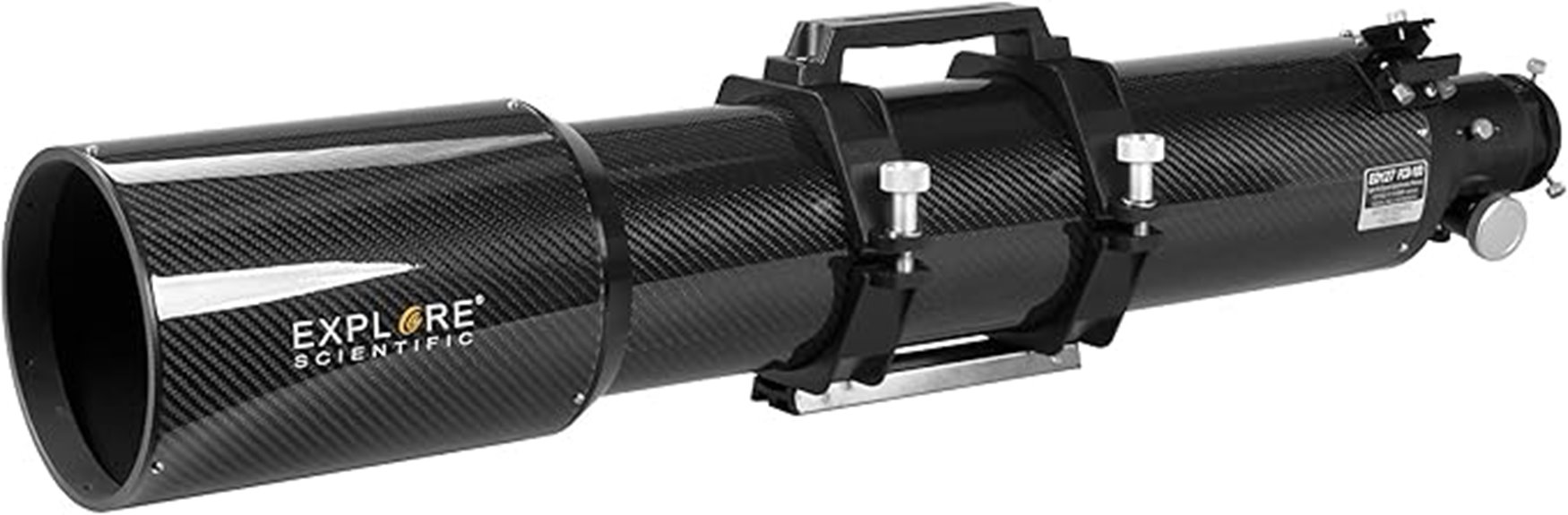
The Explore Scientific FCD100 Series 127mm f/7.5 Carbon Fiber Triplet ED APO Refractor Telescope stands out for astrophotographers who value lightweight yet high-performance gear. Weighing only 14 pounds and measuring 33.25 inches on each side, it’s easy to handle without sacrificing optical quality. Its 127mm aperture and f/7.5 focal ratio deliver sharp images with a limiting magnitude of 13 and resolution of 0.9 arcseconds. Equipped with a 2.5″ HEX focuser, it’s well-suited for astrophotography and observation. Although it has mixed reviews and a modest rating, its portability and precision make it a compelling choice for dedicated stargazers.
Best For: astrophotographers and amateur astronomers seeking a lightweight, high-quality refractor telescope for both imaging and observation.
Pros:
- Lightweight at only 14 pounds, making it highly portable and easy to handle
- High optical quality with a 127mm ED apochromatic triplet lens for sharp, color-free images
- Features a precise 2.5″ HEX focuser suitable for detailed astrophotography
Cons:
- Mixed customer reviews with an average rating of 2.3 out of 5 stars
- Limited information on warranty specifics and after-sales support
- Higher price point compared to some comparable telescopes in its class
Factors to Consider When Choosing 130MM Triplet APO Refractors for Astrophotography
When choosing a 130mm triplet APO refractor for astrophotography, I focus on several key factors to guarantee I get the best performance. These include optical quality, focal length, mount compatibility, and accessories, along with price and warranty options. Understanding these points helps me select a telescope that suits my imaging needs and budget.
Optical Quality and Corrections
Optical quality and corrections are essential factors when selecting a 130mm triplet APO refractor for astrophotography, as they directly impact image sharpness, color accuracy, and overall clarity. High-quality models use ED glass and air-spaced triplet designs to effectively eliminate chromatic aberration, producing sharp, true-to-color images. Advanced optical coatings on all surfaces maximize light transmission and contrast, revealing more detail in celestial objects. Precise lens fabrication and multi-layer coatings contribute to high Strehl ratios and minimal distortions, critical for high-resolution astrophotography. Proper optical corrections ensure a flat, distortion-free field, allowing large images without edge aberrations or field curvature. Consistent quality control and proper optical alignment are vital for maintaining these standards and achieving consistently excellent astrophotographic results.
Focal Length and Speed
Focal length and speed directly influence how you set up your 130mm triplet APO refractor for astrophotography. A shorter focal length, like f/6, offers a faster focal ratio, which means shorter exposure times and easier imaging of faint objects. Longer focal lengths, such as f/7.5 or higher, provide higher magnification, ideal for planetary detail and small deep-sky targets, but require more precise tracking. The focal length determines your field of view: shorter focal lengths give wider views suitable for nebulae and star clusters, while longer ones focus on detailed planetary imagery. Faster telescopes (lower f/number) gather more light quickly, making them advantageous for faint objects, but they can be more sensitive to optical aberrations. Your choice impacts image scale, brightness, and overall ease of capturing stunning celestial shots.
Mount Compatibility and Portability
Choosing a 130mm triplet APO refractor that fits well with your existing mount is essential for successful astrophotography. Ensuring compatibility means checking that your mount supports the telescope’s weight and has the right dovetail system, such as Vixen or Losmandy, for secure attachment. The overall weight and dimensions matter; a lighter, compact unit is easier to transport and set up, especially if you travel frequently. Make sure your mount can handle the telescope’s weight—ideally about 50% more than the refractor’s weight—to maintain stable tracking during long exposures. Using lightweight materials like magnesium alloy or carbon fiber helps reduce weight without sacrificing strength, improving portability and minimizing strain on your mount. Proper balance and compatibility are key to steady imaging sessions.
Accessories and Flat Fields
Ever wonder how to guarantee your astrophotography images come out sharp and distortion-free across the entire sensor? Flat field correction is essential, especially with full-frame or large-format cameras, to eliminate field curvature and vignetting. Many 130mm triplet APOs come with dedicated accessories like the SV209 Field Flattener, designed to optimize image quality and minimize edge aberrations. A good flat field system supports large target surfaces, up to 45mm, allowing wide-field shots without distortion. Internal light barriers and optimized optical arrangements help suppress stray light and boost contrast across the entire image plane. Compatibility is key—ensure flat field accessories match your telescope’s back focal length and threading for proper focus and peak optical performance. Proper accessories make a world of difference in astrophotography quality.
Price and Warranty Options
When selecting a 130mm triplet APO refractor for astrophotography, considering price and warranty options is essential to guarantee you get the best value and long-term peace of mind. I recommend comparing initial prices across different sellers and online stores to find a competitive deal. Watch out for additional costs like shipping fees or extended warranties, which can impact overall value. It’s also important to review the warranty’s coverage, especially regarding repairs, replacement parts, and support services, to ensure reliable post-purchase assistance. Opt for manufacturer-backed warranties whenever possible, as they typically guarantee genuine parts and authorized service centers. This combination of fair pricing and strong warranty coverage helps protect your investment and ensures your telescope remains a trusted tool for stunning celestial photography.
Frequently Asked Questions
How Do Triplet APO Refractors Compare to Doublet or Quadruplet Designs?
Triplet APO refractors generally outperform doublets and quadruplets because they offer superior color correction and sharper images. I’ve found that triplets reduce chromatic aberration more effectively, making them ideal for astrophotography. Doublets are usually more affordable but may show some color fringing, while quadruplets are complex and rare. Overall, I prefer triplets for their balance of image quality and practicality, especially when capturing detailed celestial objects.
What Maintenance Is Required for 130MM Triplet APO Telescopes?
Think of your 130mm triplet APO refractor as a fine-tuned instrument that needs regular care. I recommend checking the collimation every few months, keeping lenses clean with gentle, lint-free cloths, and ensuring the mount stays stable. Also, store it in a dry, dust-free environment. This routine keeps your telescope performing at its best, capturing pristine images of the cosmos and making stargazing a true joy.
Are These Telescopes Suitable for Beginner Astrophotographers?
Yes, I think these telescopes are suitable for beginners, especially those serious about astrophotography. They offer excellent image quality, which helps you learn the ropes and improve your shots. While they might be a bit pricier and require some initial setup and maintenance, their performance and clarity make them a worthwhile investment. With patience and practice, you’ll find them rewarding tools for exploring the night sky.
How Important Is Aperture Size Versus Optical Quality in Astrophotography?
Aperture size is like a window into the universe, but optical quality is the glass that makes the view crystal clear. I believe both matter, but optical quality often has a bigger impact on sharpness and color accuracy. A larger aperture gathers more light, revealing fainter details, but if the optics are poor, your images suffer. So, I prioritize high-quality optical quality to guarantee stunning, crisp celestial shots.
What Accessories Enhance the Performance of 130MM Triplet APO Refractors?
To boost my 130mm triplet APO refractor’s performance, I invest in high-quality accessories like a sturdy equatorial mount for precise tracking, a well-collimated diagonally cut diagonal mirror, and a reliable field flattener to improve image sharpness across the frame. Additionally, I use a good guiding scope, filters for light pollution, and a sturdy tripod. These tools help me capture clearer, more detailed celestial images.
Conclusion
Choosing the right 130mm triplet APO refractor can truly open up the universe for your astrophotography. Remember, Rome wasn’t built in a day, so take your time to select the perfect scope that fits your needs and budget. With patience and the right gear, you’ll soon be capturing stunning celestial shots that inspire awe. Trust the process—great things often come to those who wait and observe.