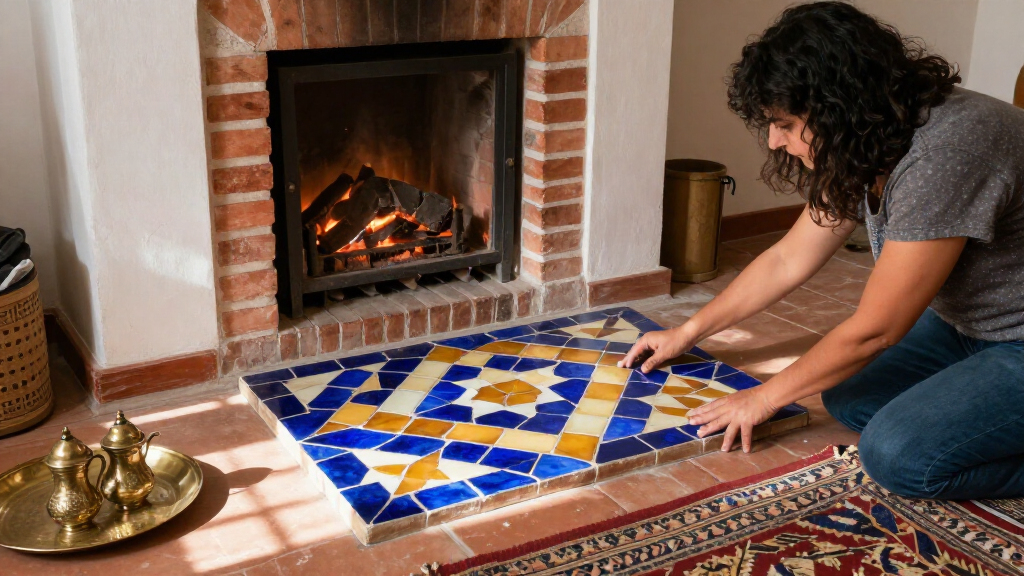

For a fireplace surround with unmistakable Moroccan character, I would start with the DYARI Mahogany Zellige for glossy, light-catching variation, the Menara Handmade Cement Tile for bold navy geometry, or the Tenedos Matte Terracotta for a quieter, more even-looking ceramic surface. These options differ more in finish and installation demands than in format: two are 4-inch wall tiles, while Menara’s larger geometric units bring a different visual rhythm and a heavier cement body.

Get furniture and decor delivered free with Prime
- Fast, free delivery on millions of items
- Prime Video, Amazon Music and more included
- Member-only deals all year
My ranking weighs how clearly each tile suits a fireplace wall, how its surface and pattern shape the finished surround, and what its material asks of the installer. The main tradeoff is artisan variation versus predictable installation: Zellige and hand-painted tiles offer more individual character, while a matte ceramic look can be easier to coordinate. I also separate decorative wall suitability from flooring claims; a fireplace surround is a wall application, but the tile and installation still need to match the heat exposure and local requirements of the specific fireplace.
Complete the kit


Key Takeaways
- Best all-around Moroccan fireplace character: DYARI Mahogany Zellige pairs Moroccan origin, glossy glaze, and tonal variation, but its irregular edges and sizing call for careful sorting.
- Best bold geometric statement: Menara’s navy-and-white handmade cement pattern reads more graphic and contemporary than the four-inch ceramic options; sealing and professional installation add work.
- Best restrained finish: Tenedos uses a matte terracotta glaze with subtle shimmer, making it a calmer choice than DYARI’s glossy mahogany or Bacalar’s painted motifs.
- Best decorative color mix: DYARI Bacalar offers hand-painted Mediterranean-inspired motifs, though its varied pattern is less suited to buyers seeking one consistent zellige field.
- Check the firebox conditions before choosing: The listed products are wall tiles, and the information provided does not establish a specific temperature rating or suitability inside a firebox.
| DYARI Handcrafted Moroccan Zellige Ceramic Wall Tiles, 4 × 4 in, Mahogany, 42 Tiles |  | Best Overall — traditional Moroccan gloss and variation | Material: Natural clay / terracotta | Finish: Glossy glazed | Tile size: 4 × 4 in (10 × 10 cm) | VIEW LATEST PRICE | See Our Full Breakdown |
| Moroccan Mosaic & Tile House Menara Handmade Cement Tile, 8″ x 9″, Navy Blue and White |  | Best Geometric Statement — bold pattern in substantial cement | Dimensions: 8 × 9 inches | Thickness: 0.5 inches | Unit count: 12 pieces | VIEW LATEST PRICE | See Our Full Breakdown |
| Tenedos 4×4″ Terracotta Matte Zellige Ceramic Tile – Handcrafted Look (50 Pieces) |  | Best for a Quieter Surround — matte, zellige-inspired ceramic | Size: 4 × 4 inches | Material: Ceramic | Finish: Matte terracotta glaze with subtle shimmer | VIEW LATEST PRICE | See Our Full Breakdown |
| Dyari Hand-Painted 4×4 Ceramic Tiles – Bacalar Set, 45 Tiles (5 sq ft) – Spanish, Moroccan & Portuguese Decorative Backsplash & Wall Art |  | Best for Painted Detail — colorful motifs for a decorative focal area | Tile size: 4 × 4 inches | Quantity: 45 tiles | Coverage: 5 sq ft | VIEW LATEST PRICE | See Our Full Breakdown |
| Moroccan fireplace tile | Material | Finish | Quantity | Coverage |
|---|---|---|---|---|
| DYARI Handcrafted Moroccan Zel | Natural clay / terracotta | Glossy glazed | 42 tiles | 4.6 sq ft |
| Moroccan Mosaic & Tile House M | Cement, natural pigments, concrete | — | — | 6 sq ft |
| Tenedos 4×4" Terracotta Matte | Ceramic | Matte terracotta glaze with subtle shimmer | 50 pieces | — |
| Dyari Hand-Painted 4×4 Ceramic | Ceramic | Glossy, high-temperature glaze | 45 tiles | 5 sq ft |
More Details on Our Top Picks
DYARI Handcrafted Moroccan Zellige Ceramic Wall Tiles, 4 × 4 in, Mahogany, 42 Tiles
For the most recognizable Moroccan zellige fireplace surround in this group, I put DYARI’s Mahogany tiles first. They are handcrafted in Morocco from natural clay, with a glossy glaze, tonal differences, and irregular edges. Those qualities can make a surround feel less like a flat, factory-uniform grid and more like a surface with depth. The mahogany color also gives the fireplace a richer, warmer presence than Menara’s high-contrast navy and white.
The distinctive surface is also the central tradeoff. DYARI says tiles may vary in size, thickness, flatness, color, and glaze, and may show pits, cracks, chips, or irregular edges. A buyer who wants evenly sized squares and tidy, repeatable grout lines may find Tenedos easier to plan around. DYARI calls for careful sorting and tight joints or no spacers, so I would budget for an installer comfortable with handmade tile rather than treating the unevenness as a minor cosmetic detail.
Each pack covers 4.6 square feet, and the product recommends ordering 15% extra for sorting and cuts. That matters on a fireplace, where the pattern and tile cuts around the fire opening and mantel can shape the whole result. The listing names fireplaces among its wall applications, a useful distinction from the other products, but it does not give a specific temperature rating. I would confirm the intended placement and installation method before using it near a working fire. Compared with Bacalar’s painted motifs, this is the better pick for a cohesive zellige field; compared with Tenedos, it gives up surface uniformity for a more traditional handcrafted effect.
Pros:- Handcrafted in Morocco from natural clay with characteristic zellige variation.
- Glossy mahogany glaze catches light and adds depth to a fireplace wall.
- Listed for interior and exterior walls, including fireplaces.
- Four-inch format supports detailed layouts around a surround.
Cons:- Differences in size, thickness, flatness, and color can complicate layout and grout joints.
- The product recommends ordering 15% extra for sorting and cuts.
- No specific temperature rating is provided for fireplace placement.
Best for: Buyers who want a traditional Moroccan zellige look with glossy mahogany color and are comfortable hiring an installer who can handle irregular handmade tiles.
Not ideal for: Buyers seeking uniform dimensions, consistent glaze, easy spacer-based installation, or a stated temperature rating for a high-heat firebox application.
- Material:Natural clay / terracotta
- Finish:Glossy glazed
- Tile size:4 × 4 in (10 × 10 cm)
- Color:Mahogany
- Quantity:42 tiles
- Coverage:4.6 sq ft
- Recommended use:Wall only; fireplace walls are included in the product description
- Origin:Morocco
Our verdict“I rank DYARI Mahogany first for buyers seeking an authentic, glossy zellige fireplace wall, provided they accept handmade variation and verify heat suitability for their installation.”
Moroccan Mosaic & Tile House Menara Handmade Cement Tile, 8″ x 9″, Navy Blue and White
Menara is the strongest choice here when the fireplace needs a large-scale geometric focal point rather than a small, glossy tile field. Its navy-and-white pattern has a clearer graphic read than either DYARI’s mahogany Zellige or Tenedos’s subdued terracotta. The 8-by-9-inch format also means fewer individual units across a given area than with the four-inch ceramic options, although the pattern repeat and cut placement still need planning.
Its cement construction changes the project as much as the look. At half an inch thick, with cement, natural pigments, and concrete listed as materials, the tile is heavier than the ceramic picks. The maker recommends professional installation, plus sealing before and after grouting to help prevent staining. Those steps make Menara less convenient than a simple decorative ceramic wall tile, but they suit a buyer willing to plan the installation around a durable, artisanal surface. The listing describes it as water-resistant and suitable for indoor or outdoor walls and floors; that versatility does not remove the need to confirm its suitability for the exact heat conditions around a fireplace.
The pack lists 12 pieces covering 6 square feet, more stated coverage than either DYARI wall set, which can simplify counting for a larger surround. Still, the format and bold contrast may dominate a small room or compete with a patterned mantel. Compared with Bacalar, Menara is more disciplined and architectural; compared with the glossy zellige picks, it offers a flatter, more graphic design language. I would choose it for a strong navy accent, not for the uneven, light-catching surface many buyers associate with Moroccan zellige.
Pros:- Distinctive navy-and-white geometric pattern suits traditional and contemporary rooms.
- Larger units create a bolder visual rhythm than the 4-inch ceramic options.
- Water-resistant construction is described for indoor and outdoor applications.
- Natural pigments and handmade production give it an artisanal character.
Cons:- Heavy cement construction may call for professional installation.
- Requires sealing before and after grouting to help prevent staining.
- The supplied details do not specify a fireplace temperature rating.
Best for: Homeowners who want a graphic navy-and-white Moroccan pattern on a fireplace wall and can accommodate heavier tiles, professional installation, and sealing.
Not ideal for: DIY beginners, buyers who prefer glossy zellige texture, or anyone unable to verify that cement tile and its installation method suit the fireplace’s heat exposure.
- Dimensions:8 × 9 inches
- Thickness:0.5 inches
- Unit count:12 pieces
- Coverage:6 sq ft
- Material:Cement, natural pigments, concrete
- Color:Navy blue and white
- Edge type:Square edge
- Water resistance:Water resistant
Our verdict“I recommend Menara for a bold, geometric surround where its weight and sealing needs are acceptable, rather than for buyers seeking classic glossy zellige variation.”
Tenedos 4×4″ Terracotta Matte Zellige Ceramic Tile – Handcrafted Look (50 Pieces)
Tenedos is my pick for a fireplace wall that should feel Moroccan-inspired without becoming the room’s loudest feature. The matte terracotta glaze and subtle shimmer offer a warmer, less reflective look than DYARI’s glossy mahogany Zellige. Its gentle shade shifts and uneven edges evoke handmade zellige, while the ceramic construction and familiar four-inch square format give the design a more controlled starting point than DYARI’s explicitly variable handmade tiles.
That comparison needs a qualification: the product still describes natural color and texture variation, so it is not a promise of a perfectly uniform field. If exact shade consistency is the goal, I would ask for current batch information before ordering. Its matte finish is also a distinct choice: it softens reflected light and can keep a surround from looking overly glossy, but it will not produce the same bright glints as DYARI’s glazed surface. Against Menara’s navy geometry, Tenedos is quieter and more tonal; against Bacalar’s hand-painted motifs, it is easier to use as a continuous background.
The listing identifies these as ceramic tiles for decorative wall applications and says they are not for flooring. That wall-only positioning fits a fireplace surround, but the supplied details do not specify a heat rating or fireplace approval. I would confirm placement guidance before installation near an active fire. The listing gives 50 pieces but no stated coverage figure in the supplied specifications, so I would not estimate the number of packs from tile count alone; ask the seller for coverage and include a cut allowance. That missing information keeps Tenedos below DYARI overall, despite its appealingly restrained finish.
Pros:- Matte terracotta glaze with subtle shimmer gives the wall a softer finish.
- Four-inch squares allow stacked, offset, and other decorative layouts.
- Natural shade shifts and gently uneven edges suggest handmade zellige.
- Ceramic construction is described for residential and light commercial wall use.
Cons:- Intended for walls only and not suitable for flooring.
- Natural color and texture variation may frustrate buyers seeking a uniform field.
- The supplied specifications do not state coverage or a fireplace heat rating.
Best for: Buyers who want a warm terracotta, matte zellige-inspired wall with a calmer appearance than glossy or hand-painted alternatives.
Not ideal for: Buyers who need stated pack coverage, require floor tile, want highly consistent color, or need a documented fireplace temperature rating.
- Size:4 × 4 inches
- Material:Ceramic
- Finish:Matte terracotta glaze with subtle shimmer
- Quantity:50 pieces
- Recommended use:Decorative wall applications
- Floor use:Not suitable for flooring
- Brand:Tenedos
- Warranty:30-Day Return Guarantee
Our verdict“I would choose Tenedos for a restrained, matte terracotta surround, but only after confirming pack coverage and suitability for the intended fireplace location.”
Dyari Hand-Painted 4×4 Ceramic Tiles – Bacalar Set, 45 Tiles (5 sq ft) – Spanish, Moroccan & Portuguese Decorative Backsplash & Wall Art
Bacalar suits buyers who want the fireplace surround to read as hand-painted decorative art, not as a restrained zellige field. Each 4-inch ceramic tile carries a motif drawn from Mediterranean, Spanish, Portuguese, and Moroccan styles, so the visual effect is more varied than the repeating navy geometry of Menara or the tonal surfaces of DYARI Mahogany and Tenedos. That makes it a strong choice for a smaller accent area, a hearth-side feature, or a surround where the room can support a lively pattern.
The listing describes a high-temperature-fired glaze that is moisture- and heat-resistant, with a glossy, fade-resistant finish. These details make Bacalar the only option in this group whose supplied description explicitly mentions heat resistance, but I would not treat that phrase as a complete fireplace specification. The information does not define a temperature limit or say that the tiles are approved for the inside of a firebox. I would confirm the intended location and installation requirements with the manufacturer or installer, especially close to direct flame or a high-temperature surface.
Bacalar’s listed set covers 5 square feet with 45 tiles, which is more coverage than the DYARI Mahogany pack and gives a buyer a useful planning figure. Its 0.31-inch thickness is also notably thinner than Menara’s half-inch cement tile. The tradeoff is pattern intensity: hand-painted variety can create a lively focal point, but it is less suitable than Tenedos if the aim is a calm, continuous backdrop. The four-inch format also means many grout joints across a larger surround, and the stated thin-set mortar and grout installation may be challenging for a first-time tiler. I rank it fourth because its cross-cultural motif is less specifically Moroccan than the zellige options, even though its painted detail is distinctive.
Pros:- Hand-painted designs give each tile an individual decorative character.
- Glossy high-temperature glaze is described as moisture- and heat-resistant.
- The set lists 5 sq ft of coverage across 45 tiles.
- Four-inch squares work for wall accents and detailed layouts.
Cons:- A mix of Mediterranean motifs is less focused on Moroccan zellige than the leading picks.
- Small tiles create many grout joints across a larger fireplace surround.
- Thin-set mortar and grout installation may be difficult for beginners.
- No specific temperature limit or firebox approval is supplied.
Best for: Buyers creating a colorful, decorative fireplace accent who like hand-painted Mediterranean motifs and can plan the layout and installation carefully.
Not ideal for: Buyers seeking a traditional, consistent Moroccan zellige field, a subdued surround, or a beginner-friendly large-format installation.
- Tile size:4 × 4 inches
- Quantity:45 tiles
- Coverage:5 sq ft
- Thickness:0.31 inches
- Material:Ceramic
- Finish:Glossy, high-temperature glaze
- Water resistance:Moisture resistant
- Installation:Thin-set mortar and grout
Our verdict“I recommend Bacalar for an expressive painted focal area, not for buyers who want the more traditional, cohesive surface of Moroccan zellige.”
How We Picked
I ranked these options for Moroccan-inspired fireplace walls, not as general-purpose tile recommendations. I looked at the character of each design, whether its finish could create a convincing focal surround, the stated material and intended use, and the practical burden of installation. Moroccan style can come from a traditional zellige surface, a repeating geometric motif, or hand-painted decoration; I treated those as distinct routes rather than assuming they are interchangeable.
I gave particular weight to how the product information describes wall suitability and surface variation. DYARI Mahogany is explicitly described for fireplace walls and has a glossy, irregular Zellige finish, so it leads for a traditional, light-catching look. Menara earns a strong place for a crisp geometric design and water-resistant cement construction, though its weight and sealing requirements make it a more involved project. Tenedos stands out for a softer matte effect and regular square format, while Bacalar is the most overtly decorative and colorful option.
I also considered what buyers may need to verify before ordering. Coverage differs, natural or hand-applied variation can affect the final appearance, and the supplied descriptions do not provide a firebox temperature rating for any option. I have not treated a general “heat resistant” description as proof of suitability for every fireplace location. For a surround near an active fire, buyers should confirm the manufacturer’s installation guidance and check applicable requirements with a qualified installer. My order reflects the best balance of fireplace relevance, Moroccan character, and practical tradeoffs—not a claim that one tile suits every hearth.
| Moroccan fireplace tile | Material | Finish | Color | Recommended use |
|---|---|---|---|---|
| DYARI Handcrafted Moroccan Zel | Natural clay / terracotta | Glossy glazed | Mahogany | Wall only; fireplace walls are included in the product description |
| Moroccan Mosaic & Tile House M | Cement, natural pigments, concrete | — | Navy blue and white | — |
| Tenedos 4×4" Terracotta Matte | Ceramic | Matte terracotta glaze with subtle shimmer | — | Decorative wall applications |
| Dyari Hand-Painted 4×4 Ceramic | Ceramic | Glossy, high-temperature glaze | — | — |
Factors to Consider When Choosing Best Moroccan Fireplace Tiles
For a fireplace, I would choose the tile by the look of the surround and the conditions where it will be installed, then plan the quantity and installation around those choices. “Moroccan” covers several visual styles in this lineup: glossy handmade zellige, matte zellige-inspired ceramic, graphic cement pattern, and hand-painted decorative motifs. They do not produce the same effect or ask for the same level of preparation.
Choose a style before comparing materials
If you picture an uneven, reflective wall with nuanced color, DYARI Mahogany is the closest fit here: its glossy glaze, irregular edges, and handcrafted Moroccan origin are central to its character. Tenedos is a calmer alternative, using a matte terracotta glaze and subtle shimmer for a warmer, less reflective finish. Menara moves away from zellige texture toward large-scale navy-and-white geometry, while Bacalar puts hand-painted motifs at the center of the design. I would use Menara or Bacalar when the pattern should define the room; I would lean toward Tenedos or DYARI Mahogany when the tile should create a more continuous surface.
Think about the rest of the room as well. A busy mantel, patterned rug, or strong stone hearth may pair more easily with Tenedos’s quieter finish than Bacalar’s multiple motifs. A simple room can make Menara’s contrast or Bacalar’s color feel deliberate. Order samples if available and view them beside the mantel and hearth in both daylight and evening light; glossy and matte finishes can read very differently under changing illumination.
Match tile and installation to fireplace heat
A tile described for wall use is not automatically suitable for every surface around a working fireplace. The listings provide different levels of guidance: DYARI Mahogany names fireplaces among its wall applications, Bacalar is described as heat-resistant, Menara is described as water-resistant for indoor and outdoor use, and Tenedos is positioned for decorative walls. None of the supplied specifications gives a precise temperature limit or confirms that the tile can be installed inside a firebox. I would confirm the exact placement, substrate, adhesive, grout, and clearance requirements with the manufacturer and a qualified installer.
Keep the firebox distinct from the outer surround. A product may be appropriate for an exterior decorative wall but unsuitable for direct flame or a location exposed to higher temperatures. Local codes and fireplace manufacturer guidance may also affect materials and clearances. If the listing does not answer the question for your specific location, do not infer approval from general heat- or water-resistance wording.
Account for handmade variation and layout
Variation is a feature only if you want it. DYARI Mahogany explicitly warns that the tiles may differ in size, thickness, flatness, glaze, and color, with irregular edges and other imperfections. This can create the uneven, light-catching effect associated with zellige, but it calls for a layout that makes room for sorting and adjustment. The product recommends ordering 15% extra for cuts and sorting. Tenedos also has natural variation, though its description emphasizes a handcrafted look rather than listing the same range of irregularities.
Menara’s larger format can make its geometric pattern read clearly across a surround, but cuts near the fire opening or mantel can interrupt that repeat if the layout is not planned first. Bacalar’s individual painted designs likewise benefit from dry-laying the tiles so similar motifs do not bunch together. For each option, measure the full area, note edges and openings, and ask the installer how cuts will affect the design before placing an order.
Compare coverage and the full project quantity
Published coverage is not consistent across these four products. Menara lists 6 square feet per 12-piece set; DYARI Mahogany lists 4.6 square feet per 42 tiles; Bacalar lists 5 square feet per 45 tiles. Tenedos gives a 50-piece count but no coverage figure in the supplied details, so I would request coverage from the seller rather than estimating from the count alone.
Measure the area after accounting for the firebox opening, mantel, side returns, and any border. Then allow extra for cuts, breakage, sorting, and future repairs. The right allowance depends on the layout and tile variation, so ask the installer to calculate it rather than ordering exactly to the measured area. Packs from different production batches may vary in shade, which can make a later replacement harder to blend into a handmade or hand-painted installation.
Decide who should install the tile
Menara’s cement body is heavy, and its maker recommends professional installation and sealing before and after grouting. DYARI Mahogany calls for careful sorting and tight or spacer-free joints, which makes installer skill especially relevant. Bacalar’s standard thin-set and grout installation may seem familiar, but its many small tiles and decorative layout can take time. Tenedos has a familiar square format, yet the supplied details do not give enough installation guidance to assume it is an easy first project.
I would discuss the proposed tile with an installer before buying, especially for a fireplace surround. Ask whether the wall can support the tile, what surface preparation is needed, which setting materials are appropriate, how the joints will be handled, and whether the tile needs sealing. For cement tile, follow the maker’s sealing instructions; for handmade ceramic, agree on how much variation is acceptable and how the installer will sort pieces.
Treat maintenance as part of the finish choice
Surface character affects cleaning and upkeep. Bacalar’s glossy glazed ceramic is described as easy to clean, and DYARI’s glossy glaze is also intended to be wipeable. Menara requires sealing to help prevent staining, so its maintenance plan differs from the glazed ceramic options. Tenedos’s matte surface offers a softer appearance, but the supplied product information does not describe a specific cleaning or sealing routine. I would ask for care instructions for the exact tile and grout combination before installation.
Grout color also changes the overall design. A close match can make a small square field feel more continuous, while contrast emphasizes each tile and may sharpen a geometric layout. With irregular Zellige edges, joint size and grout behavior are part of the visual result, not just finishing details. Decide on grout samples with the tile in hand rather than relying on a description of the tile alone.
Frequently Asked Questions
Which of these tiles is the most distinctly Moroccan?
DYARI Mahogany is the clearest traditional zellige choice because it is described as handcrafted in Morocco from natural clay, with a glossy glaze and irregular, light-catching variation. Menara also has a Moroccan-inspired geometric character, while Tenedos evokes zellige through a matte, handcrafted look. Bacalar includes Moroccan motifs alongside Spanish, Portuguese, and broader Mediterranean influences, so it is the most mixed in style.
Can I use these tiles inside a fireplace firebox?
The supplied information does not establish that any of these options is suitable inside a firebox. DYARI Mahogany is listed for fireplace walls, and Bacalar is described as heat-resistant, but neither detail supplies a specific temperature limit or confirms direct-fire use. I would ask the manufacturer and a qualified installer about the exact placement, substrate, setting materials, and fireplace requirements before purchasing.
Which tile is easiest to plan for a uniform-looking surround?
Tenedos is the best starting point if you want a quieter, less glossy field, but its listing still notes natural color and texture variation. DYARI Mahogany explicitly warns of differences in size, thickness, flatness, color, and glaze, making it a poor match for buyers who require identical pieces. Menara and Bacalar have more defined patterns, so dry-laying tiles and planning cuts will help control how those designs appear across the surround.
How much extra tile should I order?
Measure the area and account for cuts around the fire opening, mantel, edges, and any side returns. DYARI Mahogany specifically recommends ordering 15% extra for sorting and cuts; that allowance may not apply equally to every tile or layout. Menara lists 6 square feet per set, DYARI Mahogany 4.6 square feet, and Bacalar 5 square feet, while Tenedos provides a piece count but no coverage figure in the supplied details. Ask the seller or installer to confirm the amount for your project.
Which option is best for a first-time DIY installer?
None is an automatic beginner pick for a fireplace surround, since the heat conditions and wall preparation need to be checked separately. Menara is the least appealing DIY choice here because it is heavy and requires sealing before and after grouting. DYARI Mahogany’s irregular dimensions and tight-joint guidance also call for experience. Tenedos’s familiar square ceramic format may be easier to plan visually, but I would still confirm installation instructions and fireplace suitability before attempting the work.
Conclusion
For a traditional, glossy Moroccan surround, I would choose DYARI Mahogany if I wanted authentic zellige variation and had an installer prepared to sort irregular tiles. For a strong graphic focal point, Menara is the better match, as long as its weight, sealing steps, and heat suitability fit the project. Buyers seeking a calmer terracotta wall should look at Tenedos, but first ask for its coverage figure. If the goal is colorful painted decoration rather than a consistent zellige field, Bacalar brings the most individual pattern character.
Before ordering any of them, I would verify the intended fireplace location with the tile maker and installer, then calculate coverage with a cut and sorting allowance. These products differ in style and preparation, but the decisive question is whether the specific tile and installation are appropriate for the heat exposure of your surround. If that cannot be confirmed from the supplied product details, seek a clear answer before committing to the design.