
TL;DR
Design Milk’s Friday Five profiles San Francisco-based artist Grace Zhang, whose first public painting exhibition, Spacetime Monologue, presents 32 works at GCS Agency gallery through Oct. 25. Zhang connects subjects including light, financial markets, travel, Buddhist philosophy and haute couture through recurring dots, waves and geometric forms.
Design Milk’s Friday Five features Grace Zhang, a San Francisco-based artist whose first public exhibition of paintings, Spacetime Monologue, brings together 32 works at the GCS Agency gallery through Oct. 25. The interview explains how Zhang draws on finance, light, travel, Buddhist philosophy and fashion to explore patterns and structures across seemingly different subjects.

Get furniture and decor delivered free with Prime
- Fast, free delivery on millions of items
- Prime Video, Amazon Music and more included
- Member-only deals all year
The exhibition includes haute couture-inspired self-portraits, paintings informed by science and financial markets, and works from Zhang’s golf series. The source describes it as her first public exhibition of paintings and says the works span several bodies of work. Its closing date is given as Oct. 25, but the report does not state a year.
Zhang says recurring dots and waves link paintings that begin with different influences. In “Quantum Whisper,” she uses those forms to evoke light’s wave-particle duality and the way observation affects what is seen. The painting’s subject draws on the double-slit experiment, in which measurement changes the observed interference pattern.
Travel and finance meet in “Jade Hash.” Zhang says Jade Dragon Mountain’s jagged ridgeline in Lijiang reminded her of market charts, so she rendered the landscape as a simplified series of peaks and troughs. She also connects her interest in Elliott wave theory—a technical-analysis approach that proposes recurring market patterns—to the waves and emotional cycles in her paintings.
How Market Patterns Enter the Gallery
The interview offers a specific account of how Zhang turns ideas from her finance career into visual work, rather than treating the two pursuits as unrelated. She says both involve looking for patterns and making sense of complexity, with the Bloomberg Terminal and canvas side by side in her daily life.
That connection gives visitors a way into an exhibition that moves among science, landscape, couture and markets. Zhang’s paintings do not present market theory as a proven explanation of financial behavior; they use the idea of recurring rhythms as an artistic source. Her approach also brings personal interests—including Buddhist philosophy and golf—into the same exploration of order, emotion and the universe.
Products Worth Considering

TCL 85-Inch QM64L QD-Mini LED 4K Smart Fire TV

Philips Hue Bridge Pro Starter Kit with 4 A19 E26 Color Smart Bulbs

eufy Baby Monitor E21 with 4K UHD Camera and 5-Inch 720p Screen
As an affiliate, we earn on qualifying purchases.
From Finance to Painting
Zhang studied international affairs at Columbia University and works in finance alongside her art practice, according to Design Milk. She describes painting as a counterpoint to market work and a way to decompress from its intensity. The report also says she designs original jewelry and fine watches, with Paul Cézanne’s structural approach to color and form among her influences.
Her visual references range from world travel and haute couture to science and financial markets. Zhang says her paintings combine Buddhist philosophy with what she calls the structural logic she finds in Cézanne. In her self-portraits, garments and details associated with Chanel and Dior become part of compositions built from saturated colors and geometric forms.
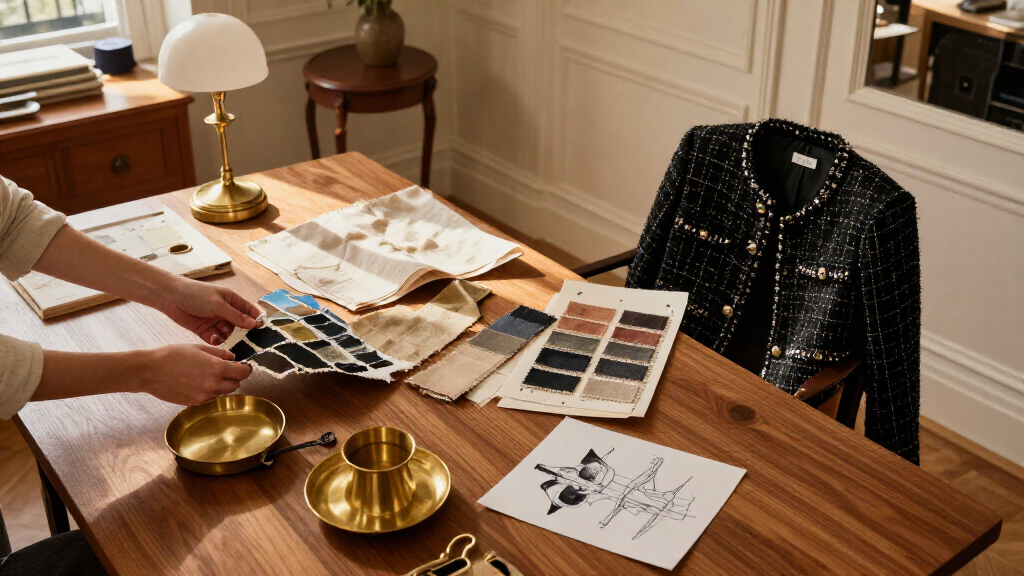
One cited starting point was Zhang’s first Chanel haute couture jacket, which she says inspired “Self Portrait I.” She interpreted its wave-like pattern through the wave nature of light, setting the garment’s blue and yellow tones against a red, universe-like background and turning reflective details into stars. The article also identifies Johann Sebastian Bach’s “Fugue No. 24 in B minor” as a creative work that has left a deep impression on her, particularly for its balance of structure and emotion.
“They may seem completely different, but both are about looking for patterns, understanding cycles, and making sense of what can initially feel like chaos.”
— Grace Zhang, quoted by Design Milk
Exhibition Dates and Visitor Details
The source lists the exhibition as running through Oct. 25 but does not provide a year, opening date, admission information or gallery hours. Readers should check with GCS Agency for current visitor details. The interview describes Zhang’s artistic intentions and influences; it does not report independent critical assessments or explain how the exhibition has been received.
The article also presents Elliott wave theory as an influence on Zhang’s thinking and imagery, not as evidence that market movements follow a reliably predictable pattern. The source does not provide details about sales, attendance or plans for the paintings after the exhibition closes.
Check the Gallery’s Current Schedule
The next practical step for prospective visitors is to confirm the exhibition’s current status and hours with GCS Agency, since the source gives no year for the Oct. 25 closing date. Design Milk’s report provides no announced follow-up exhibition, publication or other upcoming milestone for Zhang.
Key Questions
What is Spacetime Monologue?
It is Grace Zhang’s first public painting exhibition, according to Design Milk. The show includes 32 works across several series and is listed as on view at GCS Agency gallery through Oct. 25; the source does not specify the year.
What subjects appear in Zhang’s paintings?
The works draw on science, financial markets, travel, haute couture, Buddhist philosophy and golf. Zhang says dots and waves recur across these different starting points.
How does finance influence her art?
Zhang says finance and painting both involve identifying patterns and cycles. In “Jade Hash,” for example, she connects the ridgeline of Jade Dragon Mountain with the peaks and troughs of market charts.
What inspired “Quantum Whisper”?
Zhang says the double-slit experiment and the wave-particle duality of light inspired the work. She uses dots and waves as visual forms to explore that idea and the role of observation.
When can visitors see the exhibition?
Design Milk lists Spacetime Monologue at GCS Agency gallery in San Francisco through Oct. 25, but gives no year or visiting hours. Check with the gallery to confirm current access information.
Source: rss