
TL;DR
A featured home tour shows how floral designer D’Ara Nazaryan has made a 750-square-foot, 1930s Echo Park rental feel personal by working with its architecture and collecting distinctive furnishings over time. Nazaryan says the apartment’s circular layout and period details drew her to it; the account does not provide renovation costs or broader data about Los Angeles housing.
Apartment Therapy has published a tour of floral designer D’Ara Nazaryan’s 750-square-foot, 1930s rental in Echo Park, Los Angeles, documenting how she built a home around its vintage architecture, unusual circular layout and furnishings collected over time. Nazaryan says she wanted the apartment to reflect her own life and influences rather than reproduce a look seen elsewhere, offering a specific example of how a renter can make a compact home feel individual without relying on a large number of decorative objects.

Get furniture and decor delivered free with Prime
- Fast, free delivery on millions of items
- Prime Video, Amazon Music and more included
- Member-only deals all year
Nazaryan, who was born and raised in Los Angeles and is the founder of floral studio ARIS, says the apartment’s period details—including coved corners, arched doorways and French windows—felt familiar to her. She had previously lived in a downtown high-rise and described the Echo Park rental as a return to the architectural style associated with the homes and neighborhoods she knew growing up. She found the apartment three years ago and shares it with her dog, Capri.
The layout was another draw. Nazaryan describes the home’s rooms as arranged in a circle, a feature she says made the space feel unlike the standardized plans she sees in many contemporary homes. Her description of the apartment’s “flow” is her personal response to the design, not a measured assessment of the layout. The home tour identifies the apartment as a 750-square-foot rental but does not give its rent, floor plan measurements or details about the building’s ownership.
In furnishing the home, Nazaryan says she chose a mix of vintage and newer items, emphasizing a handful of prominent pieces rather than filling every area. Examples listed in the tour include vintage armchairs and an antique secretary desk found through Facebook Marketplace, a sofa and coffee table from Lulu and Georgia, a dining table from CB2 and vintage metal dining chairs. She also describes seeking out secondhand pieces at estate sales. These details show the sources of some furnishings, but the tour does not say how much they cost or whether every listed item remains in the apartment.
Why This LA Apartment Feels Personal Instead of Formulaic
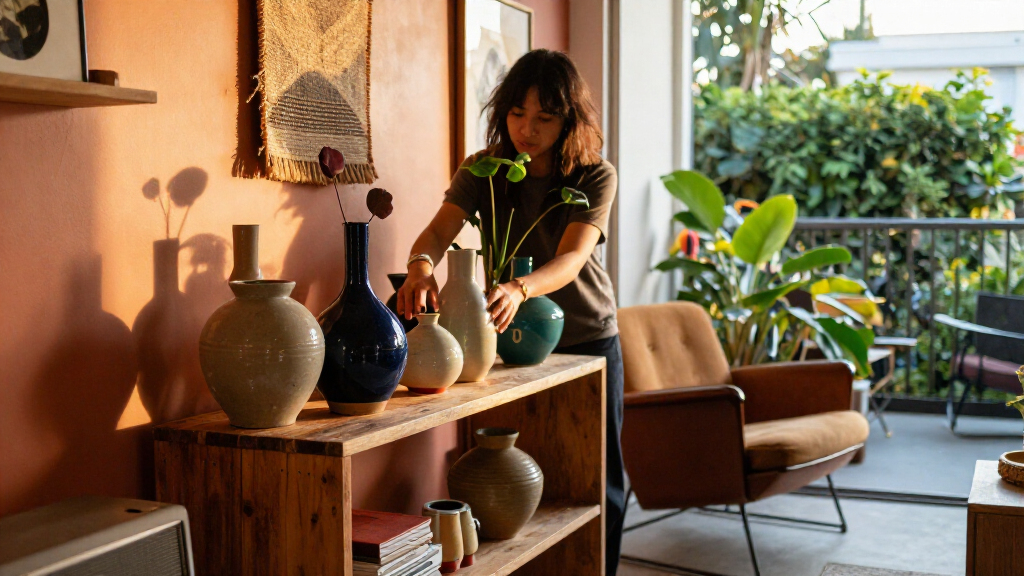
Floral designer D’Ara Nazaryan shaped her Echo Park rental around its vintage architecture and furnishings collected over time.
Architecture sets the tone
Nazaryan says the home’s details recalled the Los Angeles neighborhoods she knew growing up.
Work with what’s there
Coved corners, arched doorways and French windows shaped her choices.
A circular flow
She says the rooms arranged in a circle felt unlike standardized plans.
Collected, not filled
Selected vintage and newer pieces give the compact rental a personal mix.
- Vintage armchairs
- Antique secretary desk
- Vintage metal dining chairs
- Sofa and coffee table from Lulu and Georgia
- Dining table from CB2
A home still in motion
The tour describes an evolving interior rather than a completed renovation.
Let the apartment’s existing features guide the design.
Bring in furnishings from different sources over time.
Nazaryan says she keeps adding, removing and moving objects.
A Renter’s Personal Design Approach
The tour’s central point is not a claim that one decorating method works for every renter; it documents how existing architectural details and a distinctive floor plan shaped one resident’s choices. Nazaryan says she leaned into what was already there instead of treating the apartment as a blank space. For readers, the account offers a concrete example of decorating around a home’s fixed features and using selected, personally meaningful objects to establish character.
Her approach also puts the apartment’s age and neighborhood into the design story. Nazaryan says older Los Angeles homes connect her to places she remembers from childhood and argues that the city’s Art Deco buildings deserve preservation. That is her view; the home tour does not include an inventory of threatened buildings, preservation data or comment from city officials. Still, the apartment illustrates why residents may value older housing for more than its appearance: its proportions and details can carry personal and local associations.
The distinction matters in a small rental, where major changes may not be possible or appropriate. The tour describes a decorating process based on movable furnishings and ongoing rearrangement, not a documented renovation. It does not establish that the same approach will suit other homes, but it makes clear how Nazaryan says she made this particular space feel like hers.
Products Worth Considering

Bose Lifestyle Ultra Speaker

Dyson V15 Detect Cordless Stick Vacuum

Roborock Q10 S5+ Robot Vacuum and Mop with 10,000 Pa Suction
As an affiliate, we earn on qualifying purchases.
A Return to Echo Park Architecture
Nazaryan says she chose the Echo Park apartment after spending time in a downtown high-rise and wanting to return to a style of home connected to her Los Angeles upbringing. The tour places the rental in a 1930s building and describes architectural features that appealed to her, including arched doorways and French windows. It does not identify the building’s architect or state whether it has a formal historic designation.
The home is presented as an evolving interior rather than a finished design project. Nazaryan says she has used Pinterest for inspiration at other times but wanted this apartment to represent her own current preferences. She describes regularly adding and removing objects and moving furniture. The furnishings and room-by-room shopping list provide examples of that process, while the article does not specify a design budget, a renovation timeline or whether changes were made with a landlord’s approval.
Details the Tour Does Not Give
The published tour gives a resident’s account of the apartment and its furnishings, not an independent evaluation of the building or its history. It does not state the rental price, the owner’s plans, the apartment’s precise floor plan or whether any architectural features have protected status. Nazaryan’s concern that Los Angeles Art Deco buildings are being demolished is presented as her view; the tour does not provide figures to measure the pace or scale of demolition.
It is also unclear whether the apartment’s current appearance is unchanged since the photographs were taken. Nazaryan says she is continually adding, subtracting and moving furniture, and suggests the home may look different when the tour is published. The article does not give a date for the photography or a full inventory of the changes made since she moved in.
An Interior Still in Motion
Nazaryan says she expects the apartment to keep changing as her tastes and needs shift. The next developments described are personal rather than scheduled: she may continue to source pieces secondhand, remove objects or rearrange the furniture. The tour does not announce a renovation, a move or a preservation campaign, and it provides no dates for future changes.
For readers, the clearest follow-up is whether later photographs or an updated tour show how the apartment has evolved. Until then, the account captures one moment in an ongoing process: a renter using the features of a 1930s Echo Park home and a mix of collected furnishings to create an interior that, in her description, reflects who she is now.
Source: rss
Key Questions
Where is the apartment featured in the tour?
It is a 750-square-foot rental in Echo Park, Los Angeles, in a building described as dating to the 1930s.
Who lives in the apartment?
Floral designer D’Ara Nazaryan lives there with her dog, Capri. Nazaryan is the founder of floral studio ARIS.
What made the apartment feel personal to Nazaryan?
She points to its coved corners, arched doorways, French windows and circular layout, which she says reminded her of the Los Angeles homes she knew growing up.
Where did some of the furnishings come from?
The tour lists vintage armchairs and an antique secretary desk from Facebook Marketplace, a sofa and coffee table from Lulu and Georgia, and a dining table from CB2. It also lists vintage metal dining chairs.
Is the apartment’s design finished?
No. Nazaryan says she continues to add and remove items and move furniture. The tour does not give a schedule for future changes or a current full inventory.
Source: apartmenttherapy.com