
TL;DR
Nikken Sekkei has unveiled Hatmachida, a small civic hub in Tokyo with a distinctive copper canopy. The project aims to transform a busy street into a space for gathering and local activity. Its design integrates digital fabrication and traditional craftsmanship, serving as a prototype for urban micro-landmarks.
Nikken Sekkei has completed Hatmachida, a 22.7-square-meter community hub in Tokyo’s Machida district, distinguished by its sculptural copper canopy. The project, designed as a ‘micro-landmark,’ aims to transform a section of Haramachida Odori into a space for gathering, local commerce, and public interaction, marking a step toward activating pedestrian-friendly urban space.
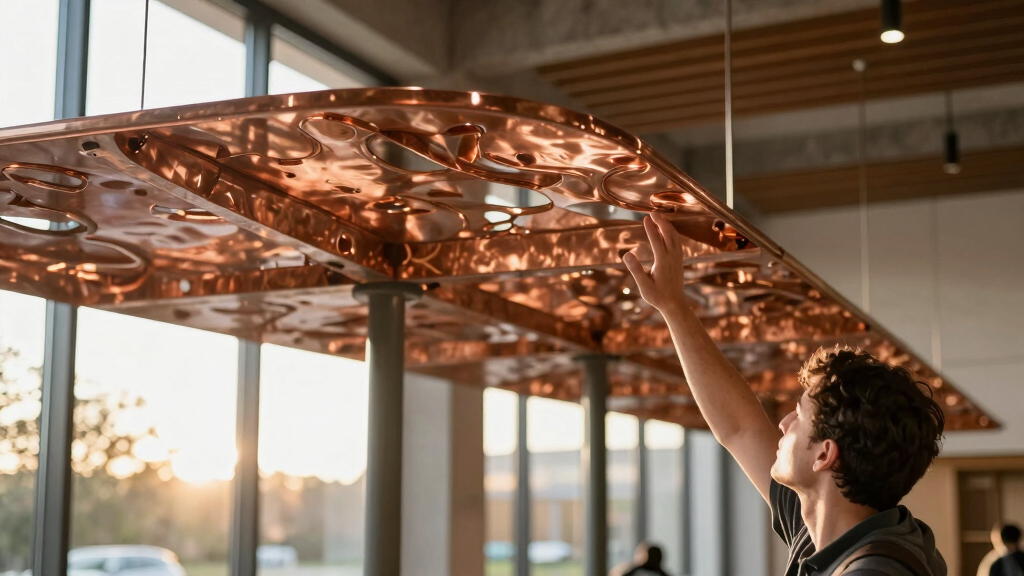
Located along a major boulevard originally designed for automobile traffic, Hatmachida occupies a strategic position between the street and the city’s pedestrian fabric. The structure features an eight-meter-high copper roof crafted with traditional ichimonji-buki standing-seam technique, which will develop a natural patina over time, adding a temporal dimension to its appearance. Beneath the canopy, a ceiling of 2,923 individually shaped plywood panels was assembled through digital design and manual craftsmanship, creating a flexible, visually engaging interior.
The hub incorporates four core functions: information, takeout, shop, and spot. These serve as points of contact for residents and visitors, supporting activities like local business promotion, community events, and informal gathering. The project emerged from social experiments conducted over two years, testing spatial configurations and interaction patterns, which informed its final design. It is intended as an evolving civic platform, capable of adapting to future community needs.
Why this small urban intervention matters for Tokyo
Hatmachida demonstrates how a compact architectural intervention can significantly enhance public life in dense, transit-oriented areas. Its sculptural copper canopy acts as a visible landmark, encouraging pedestrian engagement and supporting local commerce. The project exemplifies a sustainable approach to urban renewal, blending traditional craftsmanship with digital fabrication, and serves as a prototype for future civic micro-landmarks that can activate underused streetscapes across Tokyo and beyond.
As an affiliate, we earn on qualifying purchases.
Urban transformation along Haramachida Odori
Haramachida Odori, a major boulevard in Machida, was originally designed with a focus on automobile circulation, limiting pedestrian activity. The presence of a long-standing police box served as a local landmark, but the street’s scale discouraged linger and social interaction. In collaboration with Machida City and the Machida Community Development Corporation, Nikken Sekkei’s project seeks to reimagine this corridor as a more vibrant, pedestrian-friendly space. The hub builds on previous social experiments from 2021 and 2022 that explored how small-scale interventions could foster community and activate the street, leading to the final design of Hatmachida.
“Hatmachida is conceived as an evolving civic platform that blurs the boundaries between street, architecture, and public space.”
— Nikken Sekkei Design Team
digital fabrication plywood panels
As an affiliate, we earn on qualifying purchases.
As an affiliate, we earn on qualifying purchases.
Unclear aspects of the project’s long-term impact
It is not yet confirmed how the community will adopt and use the hub over time, or whether the project will be expanded to other locations within Machida. The durability of the copper patina and its maintenance are also still under observation, as well as the project’s ability to sustain ongoing community engagement.
As an affiliate, we earn on qualifying purchases.
Next steps for community engagement and expansion
The project team plans to monitor how the hub is used in the coming months, gather community feedback, and potentially expand similar micro-landmarks along Haramachida Odori. Local authorities and designers will evaluate the hub’s role in fostering social activity and may adapt the model for other districts in Tokyo.
As an affiliate, we earn on qualifying purchases.
Key Questions
What is the main feature of the Hatmachida project?
The main feature is its sculptural copper canopy, which provides shelter and visual identity for the community hub.
How does the copper canopy develop over time?
The copper roof is designed to develop a natural patina, changing appearance as it ages, adding a temporal dimension to the structure.
What activities are supported by the hub?
The hub supports gathering, local commerce, information exchange, and community events through its four core functions: information, takeout, shop, and spot.
Is this project part of a larger urban plan?
Yes, it is envisioned as the first in a series of similar hubs aimed at activating public space along Haramachida Odori and beyond.
Will the project be permanent?
The hub is designed as an adaptable, evolving platform, with its permanence depending on community use and ongoing maintenance.
Source: designboom