TL;DR
Designers interviewed by House Beautiful say everyday secondhand objects can make a home feel more personal without requiring costly antiques. Their suggestions include inherited items, artwork, ceramics, mirrors, lamps and tabletop decor, with safety and condition checks needed for some finds.
Designers interviewed by House Beautiful recommend looking beyond valuable antiques when shopping secondhand: everyday objects, including ceramics, artwork and table lamps, can add texture and personality at a lower cost. Their advice offers home decorators alternatives to rare or expensive pieces, though the source does not provide prices or guarantee that particular finds will be available at local shops.

Get furniture and decor delivered free with Prime
- Fast, free delivery on millions of items
- Prime Video, Amazon Music and more included
- Member-only deals all year
Lauren Sullivan of Well by Design says a home feels more interesting when its furnishings are not all selected for perfection or monetary value. She keeps her great-grandmother’s vanity set in her bathroom and a small clock from the same relative on her bedroom nightstand. Sullivan says the pieces are not especially valuable financially, but matter to her because they were passed down through generations.
Artwork and small decorative objects are another option. Becca Meyer of BB Meyer Design says some of her favorite art came from flea markets or antique shops for little money, and she prefers those pieces to mass-produced prints. Sullivan says prints, small paintings and silhouettes can bring personality without a large investment; she points to an inexpensive print of “The Skating Minister” in a vintage frame in a guest room.
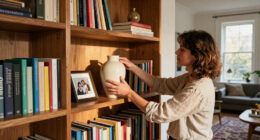
Designers also recommend pottery and ceramics, whose irregular shapes, varied glazes and signs of use can contrast with more polished finishes. Meyer says they can be displayed or used to hold utensils, branches or flowers, provided they are safe for their intended use. Joe Waroquier suggests vintage plates, copper pots, baskets and crocks as functional objects that can also be displayed. Other picks include mirrors, table lamps, candleholders, trays and vintage coffee-table books.
Skip the Costly Antiques Everyday Finds, More Character
Designers say secondhand and inherited objects can make a home feel personal without rare, expensive antiques. Choose pieces for their story, texture or use.
Nine finds to look for
Ordinary objects can bring character while serving a purpose.
Inherited pieces
Family objects can add personal history, whatever their resale value.
Prints and small paintings
Flea market art and vintage frames offer an alternative to mass-produced prints.
Pottery and ceramics
Irregular shapes and varied glazes add texture; check suitability for the intended use.
Plates, pots, baskets and crocks
Display them or use them for storage and utensils, depending on condition.
Table lamps
A secondhand lamp can add character and light; check its condition.
Mirrors, candleholders, trays and books
Small decor can bring a collected feel and, in some cases, a story of its own.
Make the mix feel personal
The designers recommend pairing older finds with contemporary furnishings and finishes.
Notice personal history, worn finishes and unusual shapes.
Decide whether a piece will decorate, provide storage or be used day to day.
Contrast vintage objects with contemporary furnishings for a collected feel.
Shop with care
Availability, cost and condition vary by item and local shop.
- Inspect the item’s condition.
- Consider your space and budget.
- Verify ceramics are suitable for food or drink.
- Have electrical concerns with used lamps evaluated by a qualified professional.
Character Without Rare Antiques
The recommendations shift attention from an item’s resale value to the way it contributes to a room. A worn finish, an unusual shape or a personal history can make an inexpensive find feel distinctive, particularly when it is mixed with contemporary furnishings. That can give shoppers a wider range of options than focusing only on scarce, high-priced antiques.
The advice is also practical: several of the suggested objects can serve a purpose as well as decorate a space. Lamps add light, baskets provide storage, and pots or ceramics can hold kitchen tools or flowers. The designers’ comments are professional opinions, however, not evidence that every secondhand purchase will be affordable, durable or suitable for every home.
Products Worth Considering

Sonos Era 100 SL Compact Microphone-Free Speaker, Black

Dyson V8 Cyclone Cordless Vacuum

Levoit Core 300S-P Smart Wi-Fi Air Purifier
As an affiliate, we earn on qualifying purchases.
Designers Favor a Collected Mix
The House Beautiful report presents the suggestions as guidance from interior designers, rather than as a survey of thrift-store inventory or a market analysis. Sullivan’s examples show how family keepsakes can sit alongside newer materials; her bathroom combines an inherited vanity set with contemporary marble and finishes.
Across the recommendations, the shared idea is to mix older objects with newer pieces rather than furnishing a room entirely with matching vintage items. Waroquier says he is drawn to patina, worn finishes and imperfect glaze, and that pairing those qualities with contemporary furnishings can make a room feel personal. The source does not document broader changes in thrift-store supply or provide a timeline for the trend.
“Often, it’s the less precious pieces that give a room its personality.”
— Lauren Sullivan, Well by Design, as quoted by House Beautiful
Availability and Condition Vary
The report does not specify typical prices, how often shoppers are likely to find these objects, or whether the recommendations apply equally across regions and stores. Its examples and evaluations come from designers, and individual results will depend on local stock, condition and budget.
It also does not offer a general safety assessment for vintage goods. In particular, Meyer’s suggestion to use ceramics is qualified: shoppers should check that a piece is safe for its intended use rather than assume an old vessel is suitable for food or drink. The source does not provide product-testing guidance or rules for evaluating electrical components in used lamps.
What to Check While Shopping
The report does not announce a follow-up event or a next publication milestone. For readers applying the designers’ advice, the next step is to browse local thrift stores, antique shops or flea markets with an eye for objects that suit their space and budget, rather than expecting to find a valuable collectible.
Before buying, shoppers can inspect an item’s condition and consider how it will be used or displayed. For ceramics intended for food, drink or kitchen use, verify suitability; for a secondhand lamp, check its condition and have electrical concerns evaluated by a qualified professional. Availability and the eventual cost of repairs remain dependent on each item.
Key Questions
Which affordable secondhand finds do the designers recommend?
The report lists inherited keepsakes, artwork, pottery and ceramics, everyday kitchen objects, mirrors, table lamps, candleholders, vintage books and trays. The designers say these can contribute texture, history or personality without needing to be rare antiques.
Do these items have to be antiques?
No. The advice focuses on secondhand and inherited objects, including ordinary items such as plates, baskets and lamps. The report’s point is that character does not depend on an object being valuable or formally classified as an antique.
How can vintage objects be used in a modern home?
Several designers recommend combining older finds with contemporary furnishings and finishes. Examples include placing an inherited vanity set beside modern marble or displaying worn copper pots and ceramics in a newer kitchen.
Are old ceramics safe to use?
Not necessarily. The report says ceramics may be useful for holding utensils, branches or flowers, but qualifies kitchen use with the instruction that the items must be safe. It does not provide testing guidance, so buyers should verify suitability before using a piece for food or drink.
Source: housebeautiful.com