
TL;DR

Get furniture and decor delivered free with Prime
- Fast, free delivery on millions of items
- Prime Video, Amazon Music and more included
- Member-only deals all year
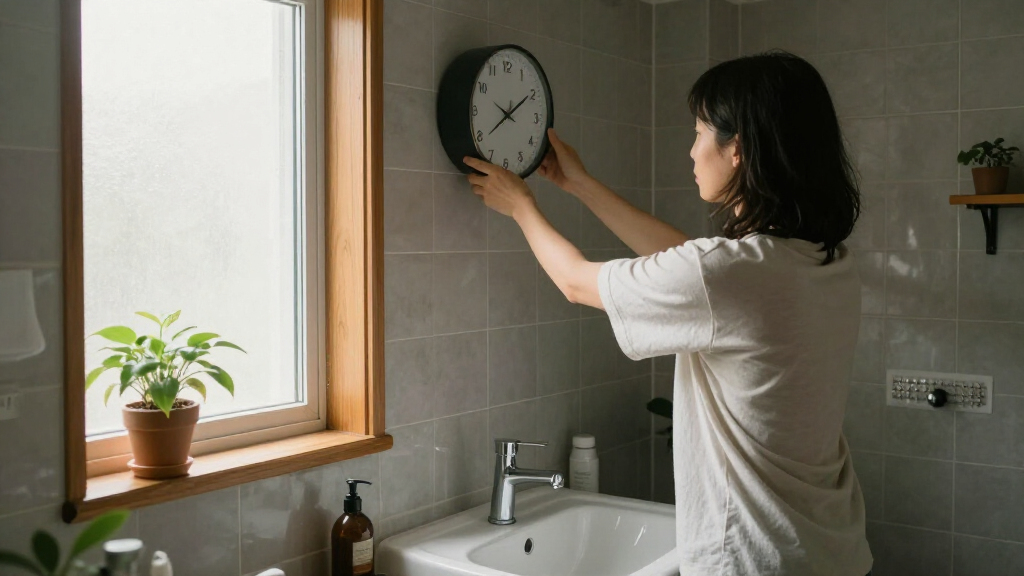
A person moved a clock into their bathroom and found it transformed their morning routine. This change reportedly increased punctuality and reduced stress, prompting discussion on environmental cues and habits.
A homeowner has reported that moving a clock into their bathroom dramatically changed their morning routine, leading to increased punctuality and reduced stress. This anecdotal account has garnered attention on social media, prompting discussions about how environmental cues influence daily habits.
The individual, whose identity is not disclosed, placed a clock inside their bathroom for the first time in recent weeks. Since doing so, they claim to wake up more consistently and start their day more calmly. The change was initially motivated by a desire to better track time during morning routines, but the effects reportedly extended beyond simple punctuality.
According to the person, having a visible clock in the bathroom helped establish a mental cue that signaled the start of the day. They reported feeling less rushed and more in control of their schedule, which contributed to a more relaxed morning atmosphere. The account has been shared on social media, sparking interest among productivity enthusiasts and behavioral psychologists alike.
Experts suggest that environmental cues, such as visible clocks, can influence habits and time management. Dr. Lisa Monroe, a behavioral psychologist at the University of California, stated, “Visual cues in key areas of daily routines can reinforce habits and reduce cognitive load, leading to more consistent behaviors.” However, she also noted that individual experiences vary and that more research is needed to confirm such anecdotal claims.
Implications of Environmental Cues on Morning Productivity
This story highlights how simple changes in one’s environment, such as moving a clock into the bathroom, can potentially influence daily habits and productivity. If verified, such strategies could be accessible tools for improving punctuality and reducing morning stress for many people. It also raises questions about the psychological impact of visual cues and how they can be harnessed to support healthier routines.
As an affiliate, we earn on qualifying purchases.
Background on Habit Formation and Environmental Cues
Research in behavioral science has long shown that environmental cues play a significant role in habit formation. For example, placing a coffee mug on a certain shelf can trigger morning coffee routines, and visual reminders can reinforce goal-oriented behaviors. The idea that a clock in the bathroom might serve as a cue for waking and starting the day aligns with these principles.
Historically, many individuals rely on alarms or external prompts to wake up, but integrating visual cues into personal spaces is a less explored approach. This anecdotal account adds to a growing conversation about how minor adjustments can support better daily routines.
While there is limited scientific data specifically on bathroom clocks, related studies suggest that consistent environmental signals can strengthen behavioral triggers, making routines more automatic and less stressful.
“Visual cues in key areas of daily routines can reinforce habits and reduce cognitive load, leading to more consistent behaviors.”
— Dr. Lisa Monroe, Behavioral Psychologist
As an affiliate, we earn on qualifying purchases.
Unverified Claims and Need for Scientific Evidence
While the anecdotal account is compelling, it remains unverified whether moving a clock into the bathroom directly causes improvements in morning routines. No controlled studies or broader data currently support this specific intervention. It is unclear how long-lasting or universal the effects might be, and whether other factors contributed to the change.
Experts caution that individual experiences may vary, and what works for one person may not work for others. Further research is needed to determine if environmental cues like bathroom clocks can reliably influence habits.
As an affiliate, we earn on qualifying purchases.
Further Research and Practical Applications Under Consideration
Researchers and behavioral scientists may explore the impact of environmental cues like bathroom clocks through formal studies. Meanwhile, individuals interested in habit formation might experiment with similar environmental adjustments. Social media and behavioral blogs could see increased discussion on simple habit-supporting strategies.
Practitioners advising on productivity and mental health may consider recommending environmental modifications as part of broader routines, but with the caveat that evidence remains preliminary.
As an affiliate, we earn on qualifying purchases.
Key Questions
Can moving a clock to the bathroom really improve my morning routine?
There is anecdotal evidence suggesting it can help by serving as a visual cue, but scientific research is limited. Results may vary between individuals.
What psychological mechanism might explain this effect?
Environmental cues can reinforce habits and reduce cognitive load, helping to establish consistent routines, according to behavioral science.
Are there other simple ways to improve morning routines?
Yes, strategies include setting consistent wake-up times, preparing the night before, and creating visual or environmental triggers to signal routine steps.
Is this a proven method for habit formation?
No, the effectiveness of moving a clock into the bathroom as a habit-forming tool is anecdotal. More scientific studies are needed to confirm its efficacy.
Should I try this at home?
If you find it helpful, it may be worth experimenting with, but keep in mind that individual results will vary and it is not a guaranteed solution.
Source: rss
Fall Picks
fall essentials
As an affiliate, we earn on qualifying purchases.