TL;DR
Angelie Xiong refreshed her New York City apartment kitchen and bathroom with narrow, vertically arranged peel-and-stick tiles in burgundy and green. Her project shows how color and tile orientation can change a renter’s plans without replacing the existing backsplash, though the installation method and future removability have not been independently tested.
Angelie Xiong used narrow, vertical peel-and-stick tiles to change the look of her New York City rental’s kitchen and bathroom, turning rooms she had planned to leave largely untouched into spaces built around burgundy and deep green. Her makeover, featured in an Apartment Therapy house tour, offers a renter-focused example of how a temporary surface update can redirect design plans without removing the existing backsplash.

Get furniture and decor delivered free with Prime
- Fast, free delivery on millions of items
- Prime Video, Amazon Music and more included
- Member-only deals all year
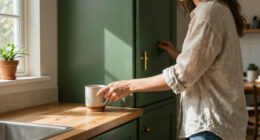
Xiong said the kitchen initially had what she called a “boring millennial gray” look. For nearly a year, she considered leaving it as it was because she expected a makeover to involve too much work. She eventually chose burgundy tiles from Mirah in the shade “Cinnamon”, pairing them with cabinets painted Behr’s “Moroccan Ruby.” The tiles’ narrow shape and vertical placement give the backsplash a different look from the more familiar horizontal subway-tile arrangement.
The existing backsplash was uneven, which complicated a renter-friendly installation. According to the house tour, Xiong considered metal sheets but found them too expensive, while wood boards were too thick. She instead attached the temporary tile layer to PVC boards, then glued those boards over the existing backsplash. The account describes her approach; it does not provide technical testing of the installation or confirm how easily the materials can later be removed.
In the bathroom, Xiong used deep green peel-and-stick tiles alongside walls painted Behr’s “Scallion.” The house tour describes the room as a relatively blank canvas before the update. The article also notes that an Amazon seller offers this vertical tile style in 30 colors, but does not identify a specific product listing or provide a full account of its performance, price, or suitability for every rental.
A renter’s makeover changed the plan
Angelie Xiong used vertical peel-and-stick tiles in burgundy and green to rethink her New York City rental kitchen and bathroom while keeping the existing backsplash.
Two rooms, two colors
A shared tile layout gives each room a distinct palette.
Burgundy and ruby
Mirah “Cinnamon” tiles pair with cabinets painted Behr “Moroccan Ruby.”
Deep green
Green peel-and-stick tiles complement walls painted Behr “Scallion.”
A workaround for an uneven backsplash
The existing surface shaped how Xiong approached the installation.
She considered metal sheets and wood boards, but found them too expensive or too thick.
She attached the temporary tiles to PVC boards, then glued the boards over the existing backsplash.
What the story establishes
| Reported | Not established |
|---|---|
| Colors, tile layout, and PVC-board method | Landlord approval or removal results |
| A design example for two rooms | Long-term durability or damage-free removal |
Color Changed the Rental Plan
The makeover matters as a practical design example because it shows how a renter’s initial decision to avoid a project can change when the update appears manageable. Instead of treating the gray kitchen as something to tolerate, Xiong used color, tile orientation and a backing layer to give the room a more deliberate look while leaving the original backsplash in place.
The story also illustrates that “renter-friendly” describes an intended approach, not a guarantee that a change is damage-free or approved by a landlord. Xiong’s workaround involved gluing materials together and then gluing the boards to the existing surface. Renters considering a similar project should check their lease and seek permission where required, and should confirm product instructions and removal risks before installing tile over a finished surface.
For readers weighing a kitchen or bathroom refresh, the example offers a design idea rather than a universal installation guide. The same tile form can read differently in burgundy or green, and the vertical layout can provide a visual change without replacing cabinets or fixtures. Whether it is suitable depends on the room, the existing surface, the product and the property’s rules.
Products Worth Considering

eufy Security SoloCam E42 4-Camera Kit, 4K Solar Security Camera System

Dyson Cyclone V10 Origin Cordless Vacuum

Shark AV2501S AI Ultra Robot Vacuum with Matrix Clean and Self-Empty Base
As an affiliate, we earn on qualifying purchases.
From Gray Surfaces to Bold Tile
The Apartment Therapy piece frames the project against the writer’s observation that narrow, vertically positioned peel-and-stick tiles have appeared in several makeovers. That repetition is an editorial observation, not sales data or proof that the style is growing across the market. The article suggests the format may appeal because it combines a recognizable subway-tile shape with a less conventional orientation and a range of colors.
Xiong’s project began with a change in her own intentions: she first considered leaving the kitchen alone, then decided to act. The kitchen and bathroom updates use different colors but a related tile treatment, helping connect the rooms while giving each a distinct palette. The reported details cover her chosen colors and installation workaround; they do not establish when the work was completed or how long it has held up.
““This was a boring millennial gray kitchen before.””
— Angelie Xiong, speaking in the Apartment Therapy house tour
Removal and Durability Remain Unreported
The house tour does not report whether Xiong’s landlord approved the installation, whether the tiles or PVC boards have been removed, or whether the underlying backsplash was left undamaged. It also gives no long-term assessment of how the adhesive performs in a kitchen or bathroom, where heat, moisture and surface conditions can affect results. Those details matter because the project is presented as renter-friendly, but the account does not establish that the same method will work safely or cleanly in other homes.
The article does not name the Amazon listing discussed for the vertical tiles, provide independent product testing, or compare costs across the available colors. Its observation that the style appears in multiple projects is not accompanied by figures on sales or trend frequency. Readers should treat the project as one renter’s design and installation experience, rather than a guarantee of product performance or lease compliance.
Check the Surface Before Installing
No further work or follow-up from Xiong is reported. For renters considering a similar change, the next steps are to review lease terms, ask the landlord about alterations if necessary, and check the tile maker’s instructions for the specific surface and room conditions. A small test area can help reveal whether the adhesive bonds as expected, but it cannot guarantee damage-free removal later.
Readers can use Xiong’s color pairing and vertical layout as design references while treating her PVC-board method as a project-specific choice. Before proceeding, they would need to assess the existing backsplash, the product’s heat and moisture limitations, and the likely cost and effort of removal. The house tour does not establish how the installation will look or perform over time.
Source: rss
Key Questions
What changed in Angelie Xiong’s rental kitchen?
She added burgundy peel-and-stick tiles in a narrow vertical layout and paired them with cabinets painted Behr’s “Moroccan Ruby.”
How did she install tile over an uneven backsplash?
The house tour says she attached the temporary tiles to PVC boards, then glued the boards over the existing backsplash. The report does not independently test the method or confirm how easily it can be removed.
What tile did she use in the bathroom?
Xiong chose deep green peel-and-stick tiles to go with walls painted Behr’s “Scallion.” The article does not specify the exact product listing for those tiles.
Is peel-and-stick tile guaranteed to be safe for a rental?
No such guarantee is established by this project. Renters should check their lease, ask the landlord where needed, and review product instructions and removal risks for their specific surface.
Source: apartmenttherapy.com