TL;DR
Interior designers Phoebe Hollond and Natasha Lyon describe using split artworks to cover televisions, with panels that open to reveal the screen. The approach can make a TV less visually prominent when not in use, though the source does not provide costs, installation details or evidence of wider adoption.
Interior designers Phoebe Hollond and Natasha Lyon are using split artworks to conceal televisions, turning a screen into a decorative feature that can be opened when needed. The custom installations offer homeowners a way to make a TV less visually prominent without removing it from the living room.

Get furniture and decor delivered free with Prime
- Fast, free delivery on millions of items
- Prime Video, Amazon Music and more included
- Member-only deals all year
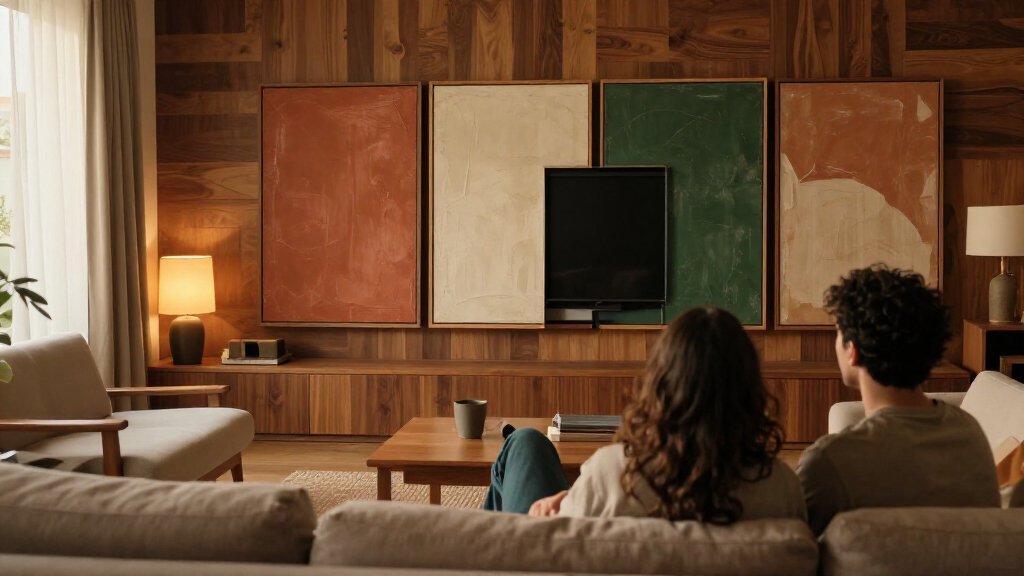
The basic arrangement places two or more artwork panels over a television. The panels sit together to cover the screen and move apart, fold or slide away for viewing. The exact mechanism depends on the project: Hollond describes a bifold cover, while Lyon says her work has included a bi-fold cabinet, artwork that slides across a media unit and tapestry-style wall coverings.
Hollond, of Studio Hollond, said she chose the approach because she considers TVs unattractive on a wall. In one example, she used a celestial map as the artwork above a fireplace. The print shows the positions of fixed stars relative to the ecliptic for 1730, according to Hollond, and was divided into two sections to form the cover.
Lyon’s approach has included collaboration with Parisian artist Andrea Mongenie. The source describes eight bespoke artworks made for a project, though it does not specify the full installation design or how the panels operate. Both designers present the method as a way to combine practical concealment with a personally chosen piece of art.
5 Ways Split Artworks Can Hide Your TV
Designers Phoebe Hollond and Natasha Lyon use artwork panels to cover televisions between uses. The custom approach keeps the screen available while making it less visually prominent.
How the panels work
Panels cover the screen, then move aside when it is time to watch.
Two or more artwork panels meet over the television.
Panels fold, slide or pull apart; the mechanism varies by project.
Designs take different forms
The cover becomes part of the room’s visual design.
Hollond’s bifold cover
A celestial map above a fireplace divides into two panels to conceal the TV.
Lyon’s collaborations
Her projects include artwork made with Parisian artist Andrea Mongenie.
Other ways to conceal a TV
Split artwork sits among several options described by the designers.
- Bifold artwork cover
- Automated lift furniture
- Bi-fold cabinet
- Sliding artwork on a media unit
- Tapestry-style wall coverings
What homeowners should check
Each installation needs to suit its screen and room.
- Panel dimensions and movement
- Mounting plan and wall clearances
- Access to cables and connections
- Cost and availability
A Screen That Disappears Between Uses
A large, dark TV can draw attention even when it is switched off. Covering it gives homeowners a way to make the living room’s artwork and furnishings more prominent while keeping the screen available for everyday use. The panels also create a design choice between displaying the TV and presenting a different focal point.
Lyon said she considers mental health alongside functionality when designing homes, and described the cover as a way to shut out some of the noise and distraction associated with screens. That is her design rationale, not evidence that a covered TV improves health. The practical value is clearer: the screen can be hidden without requiring it to be taken down or moved to another room.
For readers considering the idea, the source offers examples rather than a standard product recommendation. A split cover may suit a custom interior project, but its fit will depend on the television, wall, artwork dimensions and mechanism. The article does not give a price range or compare these installations with simpler alternatives.
Products Worth Considering

TCL 55-Inch R7D Series QLED 4K UHD HDR Roku Smart TV (55R7D, 2026)

Philips Hue Play Floor Lamp, RGBWWIC LED, 53 Inch, Black

Dreame G10 Pro Wet-Dry Vacuum Mop
As an affiliate, we earn on qualifying purchases.
From Lift Cabinets to Art Panels
Hollond and Lyon have explored other ways to conceal televisions. Hollond said she has previously designed furniture with an automated lift that raises the TV for viewing and lowers it out of sight. Lyon cited earlier projects using a bi-fold cabinet, sliding artwork on a media unit and tapestry wall hangings.
These examples place split artworks among several design approaches rather than presenting them as a replacement for all TV-hiding solutions. The panels stand out for making the cover itself a visible decorative element. Hollond drew on her interest in astrology and celestial maps; Lyon worked with Mongenie to develop art for a specific project. The source does not establish how common this approach is among designers or whether ready-made versions are available.
“TVs on the whole are ugly; they are not something you should have on your walls, so why not put them in a TV box and hide them with a piece of art.”
— Phoebe Hollond, Studio Hollond
Costs and Installation Details Are Missing
The source does not state how much the custom covers cost, how long they take to make or whether either designer offers a standard version for purchase. It also provides no dimensions, hardware specifications or guidance about how installations accommodate different TV sizes, cables, wall mounts or ventilation needs.
The designers’ comments about reducing distraction and supporting wellbeing are personal explanations for their choices. No research or outcome data is cited to show that hiding a television produces a particular mental-health benefit. It is also unclear how widely split-artwork covers are being used beyond the projects described.
Questions for a Custom TV Cover
Anyone interested in the approach would need to ask a designer or fabricator about the panel mechanism, clearances and mounting plan for their particular room and screen. They would also need to confirm whether the artwork can move safely and easily without obstructing access to the television or its connections.
The source reports no scheduled launch, new product release or follow-up announcement. Further information about availability, pricing and installation options would be needed before readers could compare split artworks with lift cabinets, sliding panels or other covers.
Key Questions
How do split artworks hide a TV?
Two or more panels meet over the television when it is not in use, then pull apart, fold back or slide away to reveal the screen. The mechanism varies by design.
Are split-artwork TV covers available as standard products?
The source describes bespoke design projects but does not say whether ready-made covers are available or provide supplier information.
What artwork can be used for a TV cover?
The examples include a celestial map and custom art made with an artist. The source presents personal interests and project-specific artwork as inspiration, rather than setting limits on the subject or style.
Do these covers improve wellbeing?
Lyon said she wanted to account for mental health and screen distraction in her design work. The source provides no research showing that covering a TV improves wellbeing, so that remains a design rationale rather than a confirmed effect.
What should homeowners check before commissioning one?
Ask about dimensions, movement, mounting, cable access and cost, and confirm that the panels work with the television and wall setup. The source does not provide installation specifications or pricing.
Source: livingetc.com